Population Data

Infographic titled "Experts refute "missing" population claim

Global Population Data Experts Refute Claims of Systematic Rural Underrepresentation

An international team of researchers, including experts from the WorldPop group at the University of Southampton, has challenged recent claims that gridded global population maps systematically undercount rural communities. In a comprehensive response to a study published in Nature Communications, the team argues that allegations of a 50% undercount are based on a flawed research design that […]

Global Population Data Experts Refute Claims of Systematic Rural Underrepresentation Read More »

Photo of a young woman checking her smartphone in a busy Philippines market.

Transforming Social Media Signals into Accurate Population Maps for Crisis Response

An international research team led by Dr Paolo Andrich, a visiting researcher at WorldPop based at the University of Oxford, has developed a novel statistical framework to turn anonymised, biased social media data into reliable population estimates. This approach provides a timely and contemporary alternative to traditional censuses, which are often static and struggle to

Transforming Social Media Signals into Accurate Population Maps for Crisis Response Read More »

Photo of the WorldPop senior team meeting with their counterparts at DHIS2, University of Oslo

Strengthening Data Systems Together: WorldPop Meets the DHIS2 Team in Oslo

Last week, the WorldPop senior team met with their counterparts at DHIS2 at their headquarters in the University of Oslo. The conversations marked an important moment to step back from day-to-day technical work and focus on the bigger picture: how population data and digital administrative systems can work together to support better public services worldwide. 

Strengthening Data Systems Together: WorldPop Meets the DHIS2 Team in Oslo Read More »

AI generated image showing public health analysts, humanitarian responders, researchers, and urban planners using tablets, maps, and data dashboards, illustrating real-world impact. Caption reads "1,000,000+ open data downloads since 2019"

Celebrating a Milestone: 1 Million Downloads and Counting

We’re thrilled to celebrate a major milestone in our mission to ensure that everyone, everywhere is counted in decision-making. Since 2019, our open spatial demographic datasets have reached over 1 million downloads from our own site – adding to the hundreds of thousands more from our data hosting partners including HDX, ESRI’s Living Atlas, and

Celebrating a Milestone: 1 Million Downloads and Counting Read More »

Photo of Willemstad, Curacao

WorldPop Strengthens Regional Partnerships at CARICOM’s 50th Statistics Meeting in Curaçao

In late October, WorldPop joined statistical leaders from across the Caribbean at the 50th meeting of the Caribbean Community’s (CARICOM) Standing Committee on Caribbean Statistics in Willemstad, Curaçao. Deputy Director Ian Coady, Senior Enterprise Fellow Dr Natalia Garavito-Tejedor and Senior Programme Coordinator, Kathryn Baxter represented WorldPop at a moment when high-quality, accessible data is becoming

WorldPop Strengthens Regional Partnerships at CARICOM’s 50th Statistics Meeting in Curaçao Read More »

Photo of delegates at the Human Planet Forum, JRC Ispra, Italy - 19–21 November 2025

Progress in Population and Urban Data: Highlights from the Human Planet Forum 2025

The 2025 Human Planet Forum gathered global experts in population modelling, urban analytics, and Earth observation for three days of scientific progress and growing collaboration. A central theme throughout the meeting was the acceleration of high-resolution, openly accessible global datasets and included a presentation by Professor Andy Tatem of our new, open Global 2 (2015-2030)

Progress in Population and Urban Data: Highlights from the Human Planet Forum 2025 Read More »

Animated GIF of Khartoum

WorldPop Global 2: A New Era of High-Resolution Population Data

This week, WorldPop Director Professor Andy Tatem presented during the Monitoring, projecting and hindcasting of human settlements, infrastructure and population session at the Human Planet Forum 2025, introducing the next generation of WorldPop’s global population datasets: Global 2 (2015–2030). These new datasets represent a major step forward in how the world measures, understands, and anticipates

WorldPop Global 2: A New Era of High-Resolution Population Data Read More »

chart showing estimated spatiotemporal resolution of human mobility data sources

Movement, Population, and Infection: How Mobility Data Is Transforming Epidemic Modelling and Control

Understanding how diseases spread in a connected world is one of the greatest challenges in modern public health. Traditional models (like the well-known Susceptible, Infectious, and Recovered (SIR) framework) often assume that everyone mixes uniformly, meaning each person has an equal chance of interacting with everyone else. But reality is far more complex. Human populations

Movement, Population, and Infection: How Mobility Data Is Transforming Epidemic Modelling and Control Read More »

Animation showing population distribution of Bogata under SSP1 scenario, 2025-2100

New Global 1 km Population Projections Released to Advance Climate and Health Research (Version 0.2)

As part of the Wellcome-funded FuturePop project, WorldPop has recently released a new open access dataset. The data includes gridded global population distribution maps at ~1 km resolution (30 arc-seconds) for every 5-year interval from 2025 through 2100, under each of the five Shared Socioeconomic Pathway (SSP) scenarios (SSP1-5). The projections feed into the Coupled

New Global 1 km Population Projections Released to Advance Climate and Health Research (Version 0.2) Read More »

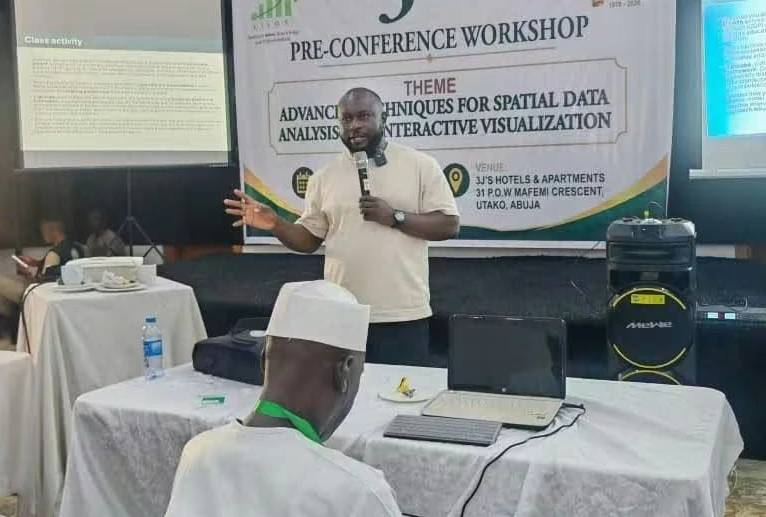
Photo of Data Science Nigeria 2025 conference hall

The Future is Geospatial: Powering Africa’s Growth with Location Intelligence

On Tuesday, October 21, Senior Research Fellow Dr. Chris Nnanatu delivered a keynote presentation at the 2025 Data Science Nigeria AI Bootcamp, where he spoke on a topic shaping Africa’s digital future: “The Future is Geospatial: Powering Africa’s Growth with Location Intelligence (LI).” Dr. Nnanatu explored how geospatial and artificial intelligence (AI) technologies are transforming

The Future is Geospatial: Powering Africa’s Growth with Location Intelligence Read More »