
UNICEF is launching the Global Child Hazard Database (GCHD) at London Climate Action Week later this month. The GCHD initiative provides globally standardised datasets on children’s exposure to overlapping climate and environmental risks. The project aims to provide timely and accurate data to support informed decision-making and policy advocacy for the world’s youth.
Central to this breakthrough is the integration of WorldPop research methods and a newly released under-18 population layer. Using high-resolution geospatial mapping, the database allows for analysis down to a 100m grid cell level. This granularity is vital for identifying “hotspots” where children face disproportionate risks from hazards such as riverine floods, agricultural drought, and extreme heat.
Traditionally, coarse data has hampered disaster relief in low- and middle-income countries. By overlaying hazard layers with WorldPop’s contemporary population data, stakeholders can now pinpoint exactly where children live in relation to specific threats. This “child-centric” approach ensures that technical spatial data is directly connected to humanitarian outcomes, such as vaccination planning and poverty reduction.
The database also introduces metrics like multi-hazard intensity, which distinguishes between frequent mild events and rare, devastating high-intensity disasters. This allows for tailored interventions based on unique hazard combinations, such as the total number of children exposed to both heatwaves and floods.
Gernot Laganda, Global Practice Director for Climate & Environment at UNICEF, will feature as a panellist at a London Climate Action Week event on Wednesday 24 June to discuss how this child-specific data can promote better climate risk responses.
The database is currently in a testing phase and will eventually be accessible through the UNICEF Data warehouse and Geosphere, a GeoAI conversation tool that uses natural language querying to simplify data access for non-technical users.
This report uses open population data and geospatial methodologies developed in part by WorldPop at the University of Southampton, UK.
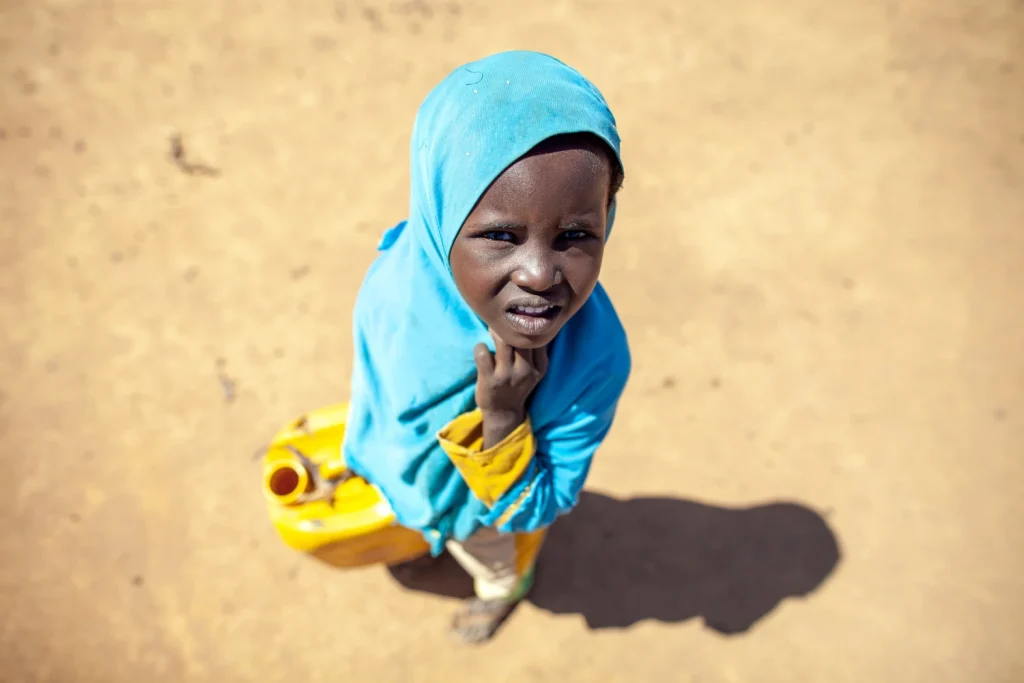
Image: Child fetching water at UNDP-funded dam in Baligubadle, Somaliland, northwest Somalia, UNDP Climate, 2019, CC BY-NC 2.0