
mapping

Photo of young men sitting close to a fishing river in South Sudan

Presenting New Research on Eradicating Guinea Worm Disease

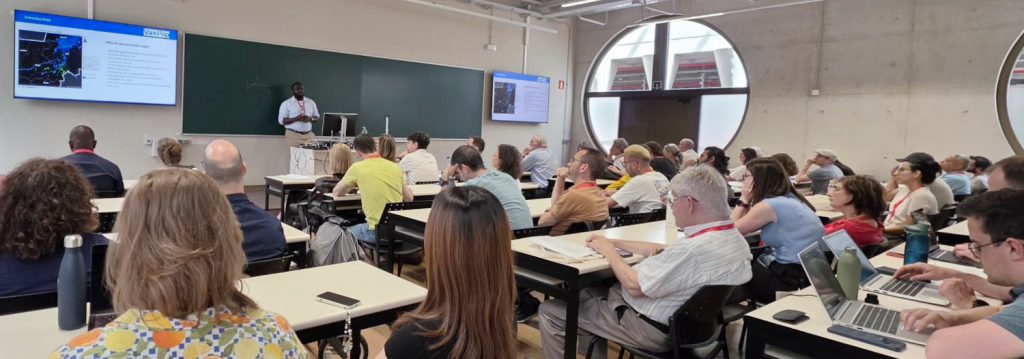
Take Our Survey and Help Shape What Comes Next Last week, Research Fellow Dr Somnath Chaudhri presented new research on mapping the risks of Guinea Worm Disease across Sub-Saharan Africa at the Intelligent Systems for Vector-Borne Disease Study Group Meeting held at The Hanse-Wissenschaftskolleg, Institute for Advanced Study in Delmenhorst, Germany.  The presentation focused on how spatial […]

Presenting New Research on Eradicating Guinea Worm Disease Read More »

Screen capture of Lagos, Nigeria population pyramid.

Open-access WorldPop data reveals hidden demographic trends across 10,000 cities

Take Our Survey and Help Shape What Comes Next High-resolution data from WorldPop is uncovering critical demographic shifts in over 10,000 cities that national averages often hide. The study, led by Dr Andrew Zimmer and published in Nature Cities, provides a globally consistent view of urban change between 2000 and 2020.  Researchers used WorldPop’s anonymised and aggregated gridded population distributions to track age and sex

Open-access WorldPop data reveals hidden demographic trends across 10,000 cities Read More »

Bangkok, Thailand

AI-driven mapping to ensure no one is left behind in rapidly growing cities

Take Our Survey and Help Shape What Comes Next WorldPop have launched a new artificial intelligence framework project to test methods for mapping urban populations with improved accuracy. This initiative aims to ensure that vulnerable residents in low- and middle-income countries are accurately represented in vital decision-making processes, from vaccine distribution to disaster response.  In

AI-driven mapping to ensure no one is left behind in rapidly growing cities Read More »

Global map showing estimated fine scale economic activity for 2024 using 2023 where unavailable

Mapping the World in Greater Detail: Why the World Bank’s New AI Research Matters 

Take Our Survey and Help Shape What Comes Next A new World Bank policy research working paper demonstrates how artificial intelligence and open geospatial data can help governments understand economies at a far more detailed local level.  Many important statistics, such as GDP, poverty, infrastructure access, or disaster risk, are usually reported only at national

Mapping the World in Greater Detail: Why the World Bank’s New AI Research Matters  Read More »

Photo of Dr Thea Woods, Dr Lawrence Hawker, Heather Chamberlain and Dr Evgeny Noi at EGU26 General Assembly

Mapping Vulnerability: Researchers Present New Climate and Population Data at EGU26

Take Our Survey and Help Shape What Comes Next Improving accuracy in geospatial data is transforming how we protect vulnerable populations from climate-driven disasters. Earlier this month, a team of researchers from WorldPop and the FuturePop project presented pioneering research at the EGU26 General Assembly in Vienna, Austria. From tracking flood-induced displacement in India to

Mapping Vulnerability: Researchers Present New Climate and Population Data at EGU26 Read More »

Photo of a street scene in Zanzibar

How AI and Data of Population Dynamics Could Help Eliminate Malaria

Take Our Survey and Help Shape What Comes Next Artificial intelligence is already reshaping fields like finance, transportation, and medicine. Now it is being deployed against one of humanity’s oldest and deadliest diseases: malaria.  With funding provided by the Web Science Institute, WorldPop is applying its AI and spatial demography and epidemiology expertise to a

How AI and Data of Population Dynamics Could Help Eliminate Malaria Read More »

Photo of Dr Edson Utazi presenting at the 2026 Guinea Worm Eradication Program (GWEP) Research Review meeting

High-resolution mapping identifies Guinea worm hotspots to support global eradication

Take Our Survey and Help Shape What Comes Next WorldPop Associate Professor, Dr Edson Utazi presented Mapping the Risk of Guinea Worm Disease project findings last week at the 2026 Guinea Worm Eradication Program (GWEP) Research Review meeting, organised by The Carter Center. The meeting brought together experts from across the world working in areas such as genomics, geospatial

High-resolution mapping identifies Guinea worm hotspots to support global eradication Read More »

Screen capture of Population Explorer interface

How Population Explorer Turns WorldPop Open Data into Action  

Take Our Survey and Help Shape What Comes Next Understanding where people live is critical in high-stakes situations. In humanitarian crises, it determines where aid goes; in commercial contexts, it shapes investment decisions. The core need is the same: accurate, granular population insight that can be used quickly. Co-founded by US-based data for development practitioner

How Population Explorer Turns WorldPop Open Data into Action   Read More »

Photograph of the Leaghany River from Ballymongan Road, Tyrone

WorldPop researchers improve mapping accuracy for rare habitats

Take Our Survey and Help Shape What Comes Next Researchers at WorldPop have pioneered a new mathematical model that significantly improves the accuracy of geospatial mapping for rare and endangered habitats.  The study, published in the International Journal of Geographical Information Science, introduces the Entropogram-based Random Field (ERF) model. This tool addresses a critical gap in environmental monitoring: the

WorldPop researchers improve mapping accuracy for rare habitats Read More »

Photo of health worker preparing a vaccine injection for a waiting mother and child

New high-resolution mapping reveals critical measles vaccination gaps in children

Take Our Survey and Help Shape What Comes Next A team of international researchers led by WorldPop Associate Professor Edson Utazi, has developed a new geospatial mapping method to identify exactly where and at what age children are missing life-saving measles vaccines. Accurate and contemporary data is essential for the success of immunisation programs in

New high-resolution mapping reveals critical measles vaccination gaps in children Read More »