

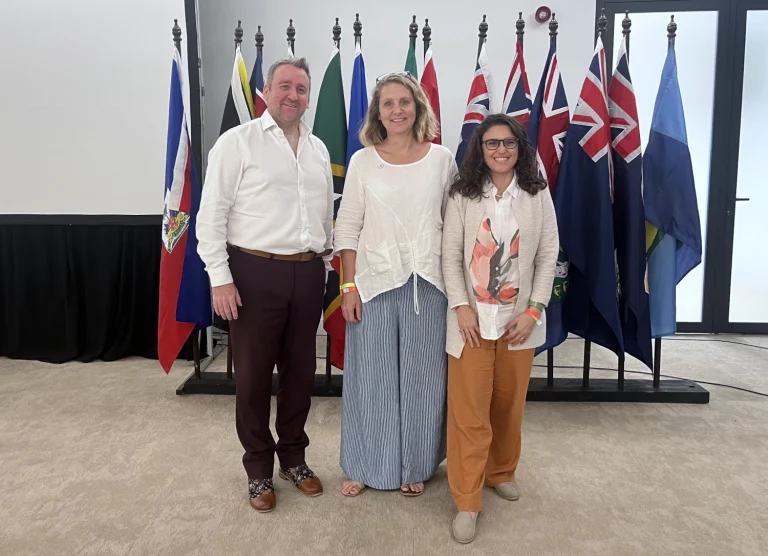
In late October, WorldPop joined statistical leaders from across the Caribbean at the 50th meeting of the Caribbean Community’s (CARICOM) Standing Committee on Caribbean Statistics in Willemstad, Curaçao. Deputy Director Ian Coady, Senior Enterprise Fellow Dr Natalia Garavito-Tejedor and Senior Programme Coordinator, Kathryn Baxter represented WorldPop at a moment when high-quality, accessible data is becoming more vital than ever for regional development and resilience.
The meeting focused on the ongoing implementation of CARICOM’s Regional Strategy for the Development of Statistics – an ambitious programme aimed at building a robust, people-centred statistical system across the Caribbean, and modernising the census to integrate new data and methods alongside traditional census processes. For WorldPop, whose work in the region is funded by the UK’s Foreign, Commonwealth & Development Office (FCDO), the gathering offered an essential opportunity to strengthen relationships with national statistics offices and to coordinate approaches with major partners such as CARICOM, UNFPA and ECLAC. This collaboration is key to avoiding duplication, enhancing efficiency, and ensuring that new modelled population estimates directly support countries’ priorities.

In her opening remarks, Curaçao’s Minister responsible for statistics, the Hon. Kimberley Lew-Jen-Tai, captured the spirit of the week and the urgency of investing in robust, inclusive data systems. She reminded participants:
“Behind every data point is a person, a community, a future… Without accurate, timely and trusted statistics, we are navigating in the dark.”
Her call to “think boldly” and to strengthen regional partnerships reflects one of the reasons WorldPop’s involvement matters. Across the Caribbean, governments are looking for innovative ways to use data to address shared challenges – economic volatility, climate change, disaster preparedness, and social inequity. WorldPop’s high-resolution spatial demographic data and open-access tools can help countries identify vulnerable communities, plan for climate-related risks, and track progress on key development and health indicators.
This CARICOM meeting also built on momentum from earlier regional dialogues, including September’s ECLAC-led discussions on climate justice and financing. Together, these engagements highlight a collective push toward data-driven solutions that link demographic data to climate resilience, social justice, and sustainable development.
As the Caribbean charts its next 50 years of regional cooperation, collaboration between institutions like WorldPop and CARICOM will be central to ensuring that decision-makers have the evidence they need, evidence that ultimately serves people and ensures that no-one is left behind.
Main image: Willemstad, Curacao by Gail Frederick, 2008 CC BY 2.0