
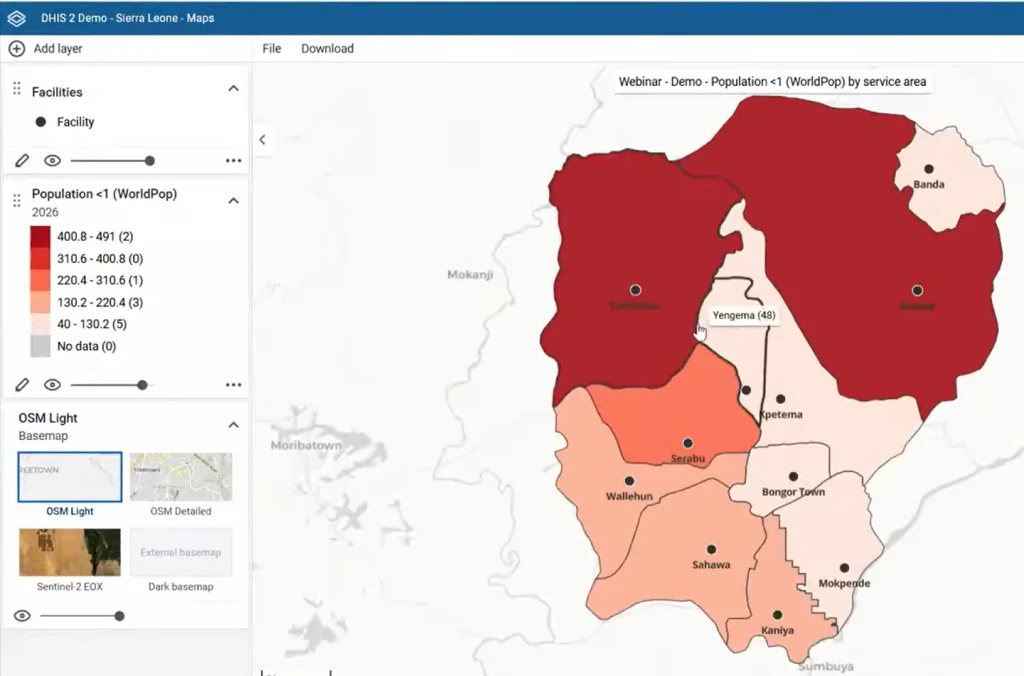
Last week, the DHIS2 community broadcast a significant webinar detailing how high-resolution WorldPop population data has been integrated into the DHIS2 platform. This digital integration is transforming how life-saving vaccines are delivered in low- and middle-income countries. With WorldPop’s 100m population grid cells now integrated in the DHIS2 mapping application, planners can now visualise where settlements are located and estimate target populations with precision.
The collaboration focuses on “microplanning,” described by experts as the engine of service delivery. By incorporating WorldPop’s 100m grid cells into DHIS2, planners can visualise settlements and estimate target populations precisely.
The YouTube -hosted webinar is divided into key sessions for viewers to explore:
- Strategic Overview of Immunization Microplanning: Daniel Oyaole, Senior Manager for Digital Health Information Systems at Gavi, the Vaccine Alliance, highlights the necessity of equitable forecasting using limited resources.
- How DHIS2 supports immunisation microplanning: DHIS2 Implementor, Stefano Perotti sets out the low- and zero-dose challenges the platform is helping to solve.
- The Central African Republic (CAR) Use Case: Maurice Mulisa and Jean Paul Mutali from HISP Rwanda explain how they mapped the CAR – a country the size of France and Spain combined that has not had a census since 2003. They identified nine new vaccination sites in the Vakaga prefecture to reach communities falling outside existing catchment areas.
- WorldPop Data and Modelling: WorldPop Director, Professor Andy Tatem, explains how satellite imagery and AI fill vital gaps when areas are inaccessible.
- Catchment Area and Accessibility Mapping: Crosscut Team Leader, Coite Manuel demonstrates how to model travel times and terrain to define realistic service territories.
- DHIS2 Integration Demo: DHIS2 Systems Engineer, Bruno Raimbault demonstrates how anonymised and aggregated population data is imported directly into DHIS2 to track campaign progress in real-time.
Beyond the CAR, the system has supported measles campaigns for 103,000 microplanning units in Bangladesh and reached 19,000 zero-dose children in Uganda.
Professor Tatem comments: “Our aim is to provide a finer-scale picture of populations. This should not be seen as a replacement for a census, but in situations where we cannot access areas, these data sources help fill vital gaps”.
The WorldPop data sets are updated annually, ensuring that health interventions remain contemporary and accurate.
The webinar was supported by Gavi, the Vaccine Alliance. All digital data used is de-identified to maintain strict privacy standards.
Learn more
Technology Partnership Program Introduction (Webinar presentation slides)
DHIS2 and Mosip Integration (Webinar presentation slides)
- DHIS2 Immunization Toolkit
- Gavi, The Vaccine Alliance
- HISP Rwanda
- Crosscut
- WorldPop Open Data
- WorldPop Free Learning Resources