
How can we move beyond national population projections to understand how populations may change in individual regions, cities and communities?
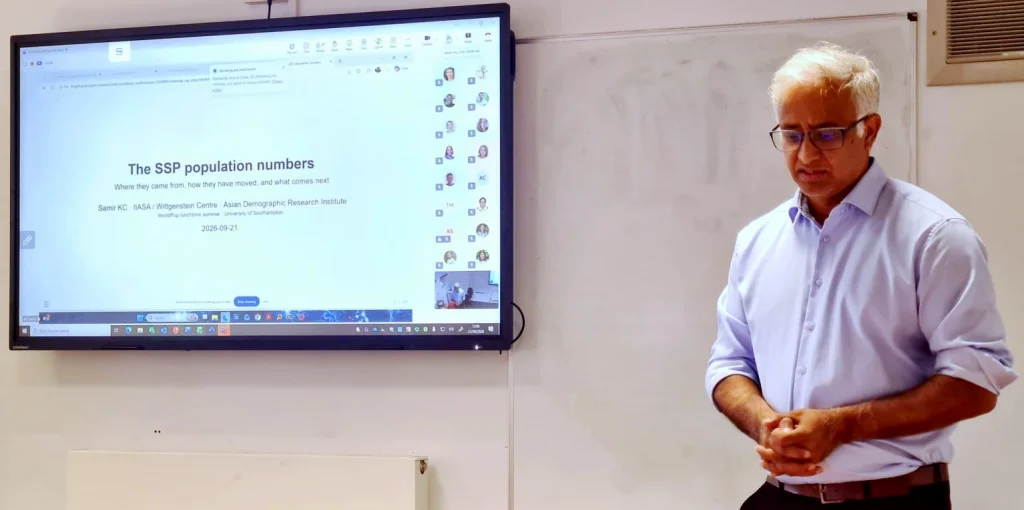
That question was at the heart of a recent visit to WorldPop by Samir KC, one of the world’s leading demographers, professor at the Asian Demographic Research Institute (ADRI), Shanghai University, and a Senior Research Scholar in the Multidimensional Demographic Modelling Research Group within IIASA’s Population and Just Societies Programme. During his visit, Samir met with researchers involved in the FuturePop project, helping to build collaborations around the development of subnational Shared Socioeconomic Pathway (SSP) scenarios.
FuturePop is exploring how advances in demographic modelling, geospatial data and artificial intelligence can help create more detailed and useful population projections. While SSPs are widely used in climate, development and sustainability research, they are primarily developed at national scales. FuturePop aims to help bridge the gap between national projections and the local population information needed by policymakers, planners and communities.
During his visit, Samir delivered a seminar sharing insights into the development of the SSP population projections that underpin many of the scenarios used by the global climate and development research community. He explained how the SSP framework brought together demographers, economists and climate scientists, and how the population and education projections at its core were produced for every country by age, sex and level of education.
A key focus of the seminar was the evolution of these projections over time. Samir described how successive releases, in 2013, 2018 and 2023, have incorporated new demographic evidence, mainly on fertility and on the starting population. Each release has raised the expected world total: in the middle-of-the-road scenario (SSP2), world population is now projected to peak at about 10.1 billion around 2080.
Perhaps most relevant to FuturePop was Samir’s discussion of what comes next. He highlighted growing demand for projections below the national level, reflecting the reality that demographic change is highly uneven across countries. Population growth, migration, educational attainment and urbanisation often differ dramatically between regions within the same nation. Understanding these patterns is essential for planning infrastructure, healthcare, education systems, climate adaptation and disaster response.
Drawing on examples from Nepal, India and Europe, Samir showcased research that integrates demographic modelling with spatial data to produce more geographically detailed projections. His work explores how population change can be modelled at subnational scales while remaining consistent with national SSP assumptions, an area of growing importance for FuturePop and the wider research community.
The visit also discussed upcoming global population projections being prepared by Samir and colleagues at the Wittgenstein Centre for Demography and Global Human Capital (WIC) and IIASA. While WIC traditionally updates projections every five years (2013, 2018, 2023), this round is a comprehensive revision using new data, updated methods, and over a decade of insights. The team will update SSP population and human capital projections for the official SSP database (v4.0) whenever the scenario community calls for the next round.
Discussions with the FuturePop team explored how these global scenarios might be extended and refined at subnational scales, opening new opportunities to connect demographic futures with geospatial modelling and decision-making. As climate, development and population challenges become increasingly interconnected, improving our ability to understand where people will live, move and age is becoming just as important as knowing how many people there will be.
For WorldPop researchers, Samir’s visit highlighted the value of bringing together expertise in demography, spatial data science and population modelling. By strengthening collaboration around subnational SSP development, FuturePop is helping lay the foundations for a new generation of population scenarios that can better support decision-making from global assessments all the way down to local communities.
Learn more
- FuturePop (WorldPop)
- The human core of the shared socioeconomic pathways: Population scenarios by age, sex and level of education for all countries to 2100 (Global Environmental Change)
- Shared Socioeconomic Pathways (SSP) Database (IIASA)
- Wittgenstein Centre Data Explorer
- Samir KC profile (IIASA)
- WorldPop Open Data
- WorldPop Free Learning Resources