
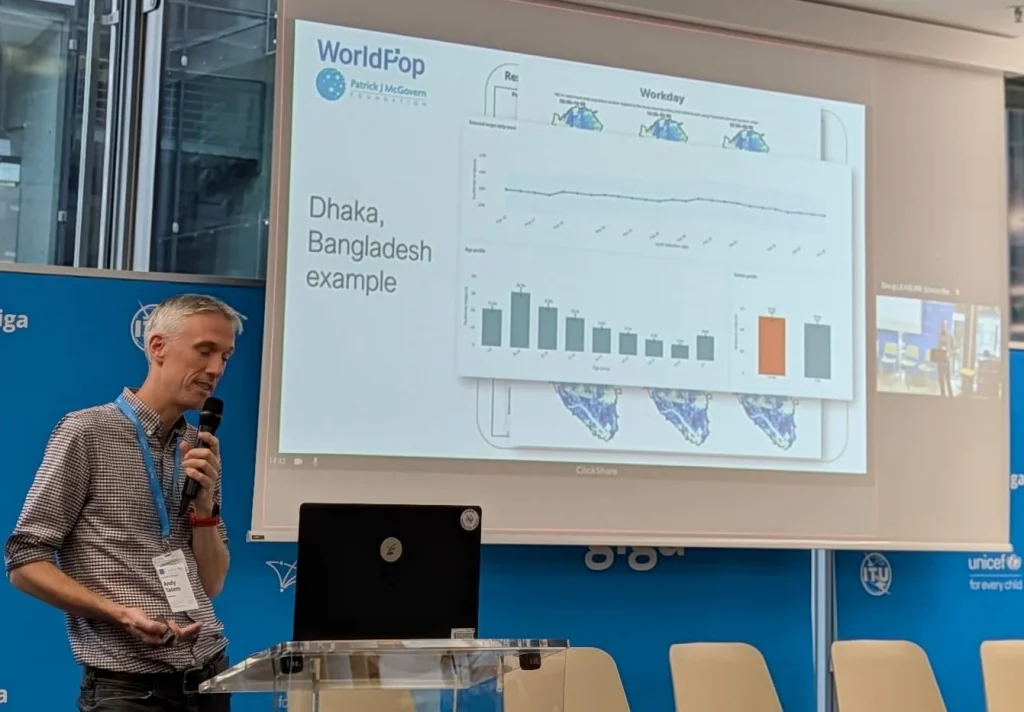
Last week, I travelled to Geneva for UNICEF’s Ahead of the Storm workshop, a gathering of scientists, policymakers, and tech innovators united by a clear mission: using high-quality data and exploring the potential of artificial intelligence to protect children from climate emergencies. As climate change and phenomena like El Niño intensify, the window between a disaster striking and lives being saved is shrinking. The workshop brought together experts to explore how we can combine different datasets and methods to forecast risks faster, assess impacts more accurately, and deliver aid where it’s needed most.
At the heart of this effort is UNICEF’s Children’s Climate Risk Report 2026. The report paints a sobering but necessary picture: children are disproportionately vulnerable to climate change. Because of their developing bodies, limited agency, and heavy reliance on caregivers and local infrastructure, they face unique risks from extreme heat, flooding, drought, and disease. The report maps these vulnerabilities globally, revealing that tens of millions of children live in areas with high exposure to climate hazards and low capacity to adapt. It’s a stark reminder that climate change is a child protection crisis.
This is where data becomes a lifeline. At WorldPop, we’ve been working closely with UNICEF to provide high-resolution population datasets that break down exactly where children under 18 live across the globe. For the Children’s Climate Risk Report, we developed a bespoke under-18 version of our Global2 dataset, and it’s now becoming the demographic basis of emergency response. Nearly every presentation at the workshop relied on our population data, and it was incredibly rewarding to hear teams thank the WorldPop group for making their work possible.
The impact is already rippling outward. What started as global collaboration is now being adapted at the regional and country levels. Governments and response agencies are building locally tailored versions of Ahead of the Storm tools using the WorldPop Global2 data. For example, UNICEF’s Asia-Pacific office has integrated our datasets directly into their first-response platform, helping officials prioritise evacuations and resource allocation during disasters. Our data is also being used at the Giga Global offices by UNICEF and ITU to map school and health facility coverage alongside internet connectivity, ensuring that the most vulnerable communities aren’t left offline when emergencies strike.
Beyond UNICEF, the workshop sparked valuable conversations with partners from the International Telecommunication Union (ITU), Microsoft Data for Good, and companies working with mobile network data. I also used the trip to catch up with colleagues at WHO, Gavi, and the Group on Earth Observations (GEO) to align our latest work and explore new collaborations.
Climate emergencies won’t wait for perfect solutions, but with better data, smarter AI, and stronger partnerships, we can get ahead of the storm. Protecting children from climate change starts with knowing where they are, how many there are, and how to reach them when disaster strikes.