
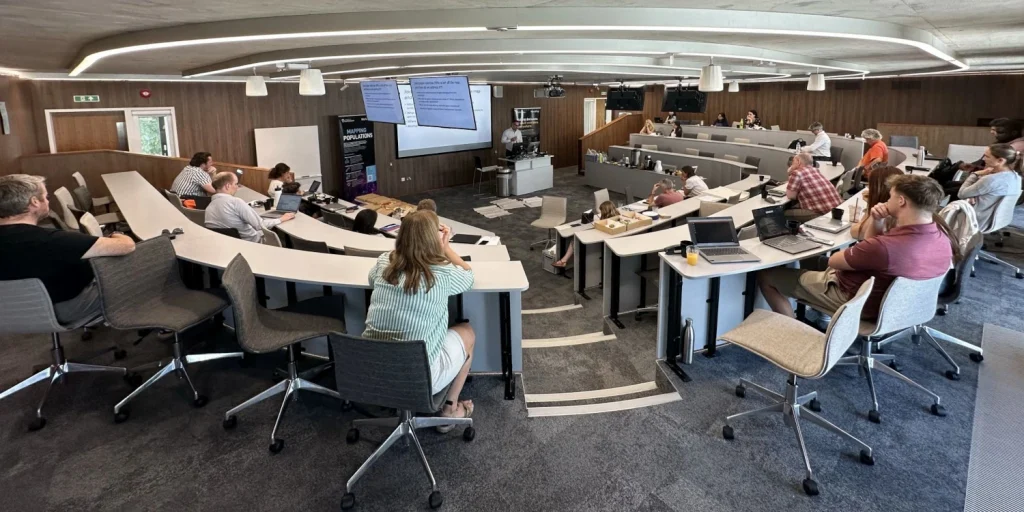
WorldPop recently convened a specialised international team to transform how the world tracks and responds to forced displacement. Experts from UNHCR, IOM, UNICEF, IDMC, FCDO, the IDMC and leading global universities including University of Oxford, Cambridge, Liverpool and Bristol gathered at the University of Southampton to address the urgent need for timely and accurate data to protect the world’s most vulnerable populations.
With global instability, conflict, and climate change driving forced displacement to record levels, the workshop focused on making underserved groups, particularly women and children, visible in humanitarian data. Participants emphasised that contemporary geospatial mapping and robust data are essential to place these individuals at the centre of decision-making.
Meeting organiser, Dr Sarchil Qader comments, “Now more than ever, innovation and strengthened local capacity are essential to ensure these groups are visible and their needs are accurately understood”.
The two-day session prioritized the responsible use of AI and digital trace data, ensuring all mobile or digital information remains anonymised and aggregated to maintain privacy. Discussions centred on:
- Improving the integration and interoperability of displacement data.
- Closing critical data gaps using high-resolution geospatial tools.
- Strengthening the links between academic research and operational policy decisions.
A central theme of the workshop was exploring innovative ways to make displacement data more timely, consistent, and geographically detailed. Participants discussed how cutting-edge advances in geospatial analytics, artificial intelligence, and data integration can strengthen the evidence base that policymakers and humanitarian organisations rely on to better understand, anticipate, and respond to the needs of displaced and vulnerable communities. These discussions sparked several proposals for collaborative research and cross-sector partnerships aimed at accelerating the development, adoption, and real-world application of these emerging solutions.
The workshop concluded with a strong commitment to establishing a broader community of practice and pursuing joint research proposals. Partners from the Universities of Oxford, Cambridge, and Bristol joined international agencies in pledging to strengthen the evidence base for data-driven humanitarian action.