
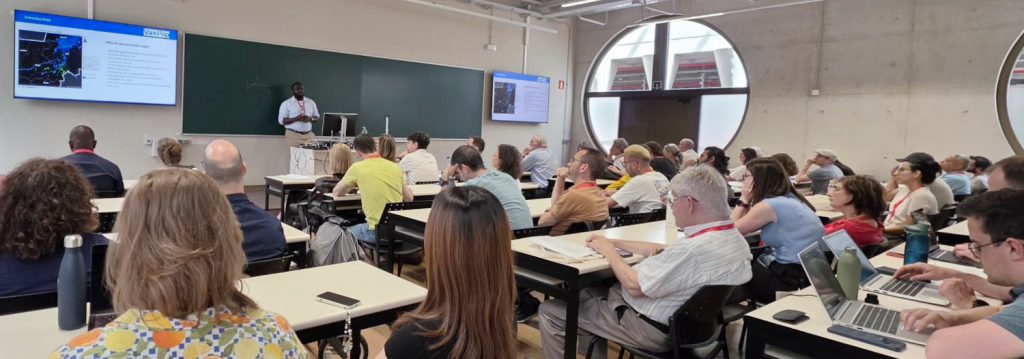
Last week, WorldPop researchers demonstrated how advanced geospatial mapping and machine learning can solve critical global health challenges, from tracking viral tourism trends to reaching “zero-dose” children. Presenting at the GEOMED 2026 conference at the Public University of Navarre, Pamplona, Spain, Dr Edson Utazi, Krishnaveni KS and Jiantong Han revealed how contemporary data can transform public health interventions in low- and middle-income countries.
Mapping the Risk of Guinea Worm Disease
In the fight to eradicate Guinea worm disease, Associate Professor, Dr Utazi demonstrated the power of combining geostatistical models with machine learning. Because cases are now limited to remote areas of Africa, health workers require high-precision data to guide surveillance.
The team developed high-resolution maps to identify transmission hotspots. Dr Utazi comments: “By using these predictive tools, we can provide health agencies with more precise inferences at a lower cost than traditional sampling, directly supporting the goal of total disease elimination”.
Predicting the “Spillover” of Dengue Fever
PhD researcher, Jiantong Han revealed a novel social trigger for disease spread: TV drama-driven tourism. Han’s study analysed aggregated social media buzz and anonymised migration data following the release of the romantic show Meet Yourself, which was filmed in China’s Yunnan Province.
The research identified a significant surge in domestic travel to the region in the post-pandemic era. This region is one of the epicentres of dengue fever in China’s border areas. Han highlighted how these culturally mediated mobilities may create new spillover risks, requiring health systems to implement mobility-aware prevention strategies.
Identifying Barriers to Childhood Vaccination
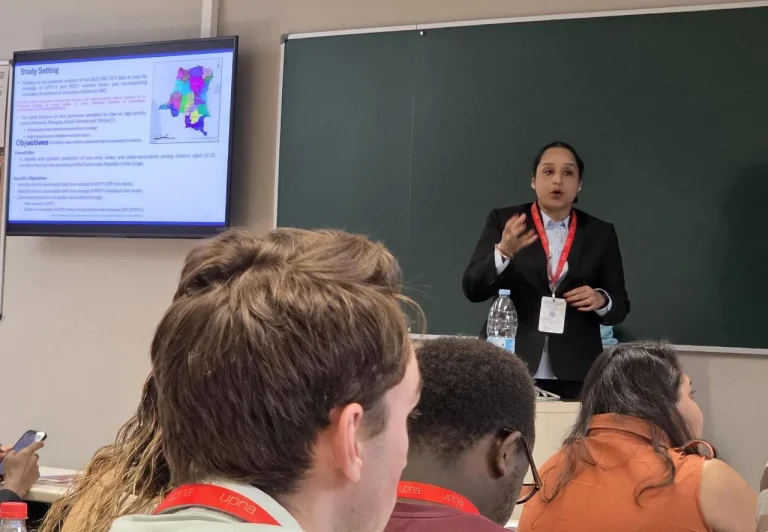
Reaching “zero-dose” children (those who have never received a single vaccine) remains a priority for global health equity. Senior Research Assistant, Krishnaveni K.S. presented research examining the factors associated with zero-dose and under-vaccination among children aged 12–23 months in four priority provinces of the Democratic Republic of the Congo. Using data from “Enquete de Couverture Vaccinale” (household vaccination coverage survey) (ECV 2023) combined with geospatial and community-level information, the study explored how individual, household, behavioural, and health-system factors influence vaccine uptake.
The findings highlight that barriers to childhood vaccination extend far beyond physical access to health services. Caregiver motivation, confidence in vaccines, knowledge of vaccine-preventable diseases, birth registration, possession of health documents, place of delivery, and the quality of interactions with health workers were all important predictors of vaccination status. By applying advanced spatial and statistical methods, the research provides evidence to support more targeted, locally tailored interventions aimed at reducing immunization inequities and ensuring that no child is left behind.
Humanitarian Impact
The findings presented by WorldPop at GEOMED 2026 underscore the necessity of timely and accurate data for global health decision-making. By turning complex spatial data into actionable maps, researchers are providing a roadmap for more resilient and equitable health systems.
GEOMED is the biennial international conference on spatial statistics, geographical epidemiology, and public health, with the 2026 edition organised by the Public University of Navarre, Spain.
Learn more
- Mapping the risk of Guinea worm disease in sub-Saharan Africa using geostatistical and machine learning approaches (GEOMED Abstract pdf)
- How TV Drama-affected Social Media Buzz Influences Human Mobility and Dengue Spread in Post-Pandemic China? (GEOMED Abstract pdf)
- Predictors of Zero-Dose and Under-Vaccination Among Children in the Democratic Republic of the Congo (DRC) (GEOMED Abstract pdf)
- Mapping the risk of Guinea Worm Disease at a high resolution using geostatistical and machine learning approaches (WorldPop project)
- WorldPop Open Data
- WorldPop Free Learning Resources