
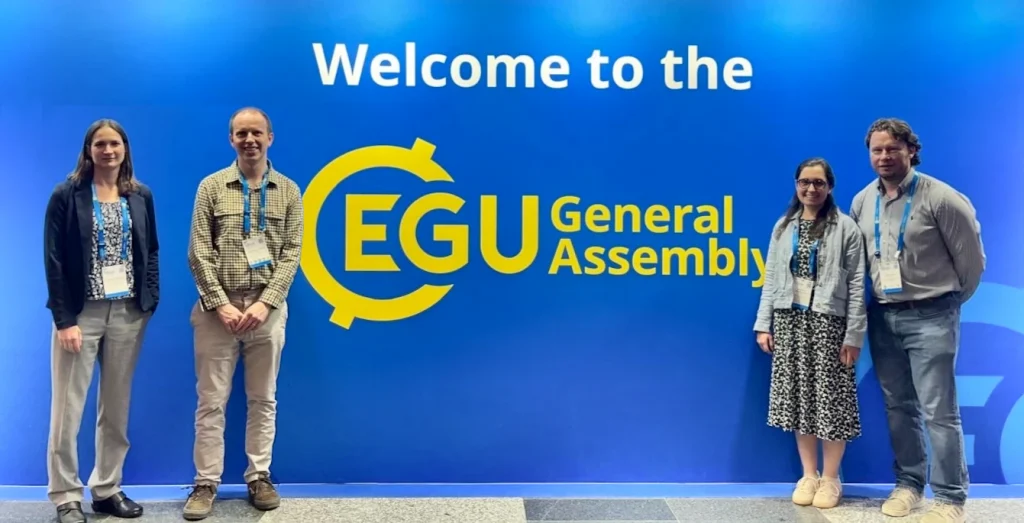
Improving accuracy in geospatial data is transforming how we protect vulnerable populations from climate-driven disasters. Earlier this month, a team of researchers from WorldPop and the FuturePop project presented pioneering research at the EGU26 General Assembly in Vienna, Austria. From tracking flood-induced displacement in India to modelling the future of global cities, these researchers are providing the timely and contemporary data necessary for effective humanitarian response and long-term environmental planning.
The European Geosciences Union (EGU) General Assembly is the largest geosciences event in Europe, attracting over 20,000 scientists worldwide to address critical societal and environmental challenges. This year, WorldPop experts took a significant role in shaping the agenda for how data-driven evidence supports transparent decision-making under uncertainty.
Leadership in Data-Driven Planning
Dr Evgeny Noi and Dr Laurence Hawker (University of Bristol) chaired influential sessions that bridged the gap between complex physical modelling and real-world governance. From the FuturePop project Dr Hawker co-chaired a session on climate risk storylines (https://www.egu26.eu/session/57467), exploring how to co-produce narratives with stakeholders to make future climate scenarios actionable for policymakers. Meanwhile, Dr Noi convened a session on data-driven planning (https://meetingorganizer.copernicus.org/EGU26/session/57498), which focused on how high-resolution population grids can be used to manage nature-based tourism and disaster risk in changing environments.
Predicting Mobility and Risk
Dr Ekta Aggarwal presented innovative research on detecting population movements during severe floods in Bihar, India. By integrating anonymised and aggregated Facebook user data with satellite-derived flood maps, the study found that active user counts declined by approximately 35% during flood periods. This approach provides granular insights into displacement in low- and middle-income countries, where traditional mobility data are often sparse.
Further addressing climate exposure, Dr Heather Chamberlain highlighted the critical role of dataset choice in risk assessments. Research she is leading demonstrated that flooding exposure estimates vary considerably depending on which gridded population dataset is used. Chamberlain noted that results underscore the critical role that accurate future small area population estimates have in robust exposure and vulnerability analyses.
Mapping the Future
Dr Hawker also unveiled the latest updates to global population projections that extend to the year 2100, derived from analysis undertaken during the FuturePop project. These high-resolution 100m grid cells allow for detailed climate impact studies by disaggregating data by age and sex to assess specific vulnerabilities. Dr Noi contributed to this field by presenting new data-driven methods to predict urban expansion in fast-growing cities like Accra, Ghana, using neural networks to improve prediction accuracy by 65%.
Finally, Dr Thea Woods presented a systematic review of 222 studies, confirming that gridded population data has become foundational infrastructure for climate-health research. Her work emphasises the need for continued dataset development to act as a bridge between climate science and public health action.
Featured Papers at EGU26
- Detecting Flood-Induced Population Mobility Using Social Media and Satellite Data
- FuturePop – Constructing global gridded population maps at multiple scales for SSP scenarios
- The Role of Gridded Population Data in Shaping Future Exposure Estimates
- A systematic review of the use of gridded population datasets in the assessment of climate-health risks