
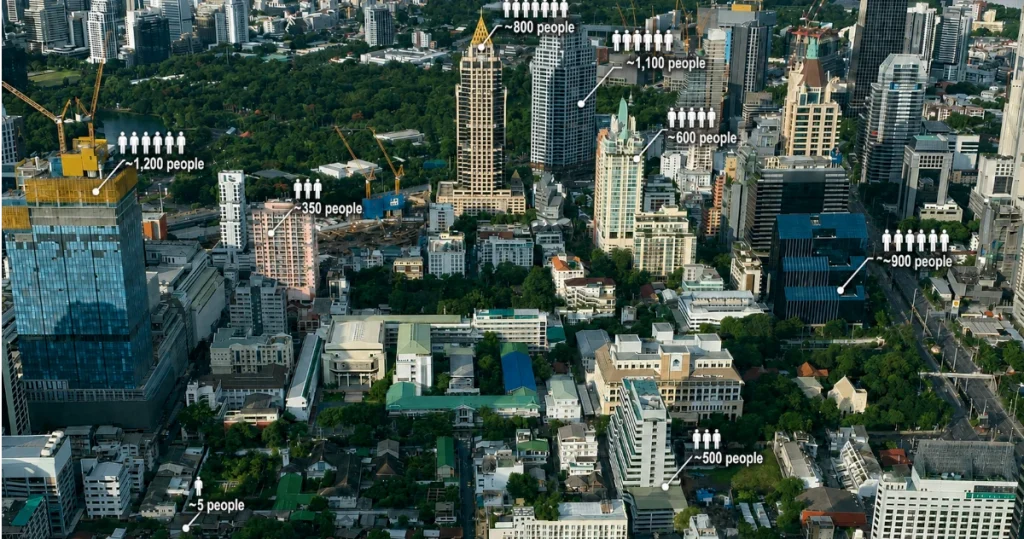
WorldPop have launched a new artificial intelligence framework project to test methods for mapping urban populations with improved accuracy. This initiative aims to ensure that vulnerable residents in low- and middle-income countries are accurately represented in vital decision-making processes, from vaccine distribution to disaster response.
In many settings, traditional population data from national censuses can quickly become outdated or incomplete. This is especially true in large, complex urban environments where population density can vary by orders of magnitude between adjacent blocks. When people are missing from the map, services are distributed inequitably and resources are often wasted.
To bridge these data gaps, our project team are testing the creation of a hybrid “GeoAI” modelling framework. This system will combine and evaluate traditional novel AI-derived datasets, including Google’s OpenBuildings 2.5D and satellite embeddings in their ability to estimate population distributions. By using anonymised and aggregated mobility metrics from Meta, the team will also test whether such datasets can reliably measure how urban populations shift between day and night and across weeks, months and seasons.
Project lead, Professor Andrew Tatem, comments: “In rapidly changing cities, populations are a moving target that is difficult to measure using traditional data sources like censuses and household surveys. This project aims to test the ability of new AI-derived geospatial datasets in their abilities to measure and map urban populations at small area scales over time”.
The 12-month project, supported by a $500,000 (£373,300) grant from the Patrick J. McGovern Foundation, will see researchers collaborate directly with national statistical offices and researchers in rapidly changing cities such as Dhaka and Bangkok. These partnerships will ensure the insights and outputs are tailored to local needs and can be adopted beyond the lifetime of the project.
Image: Derived from Bangkok, Thailand, Marcelo Benzuca (Pexels), 2024.