
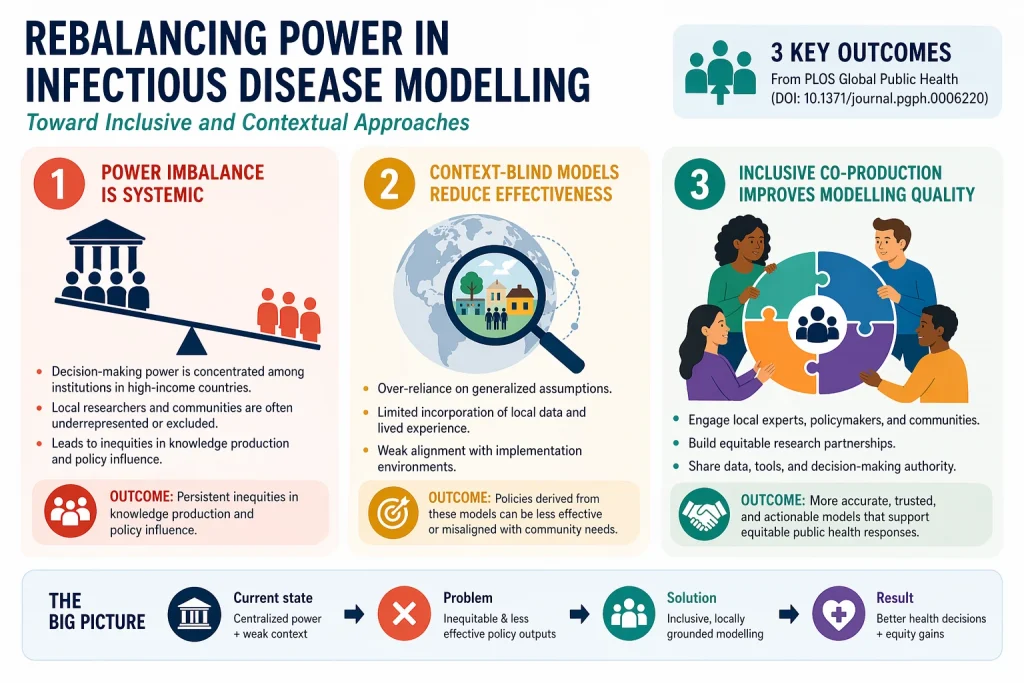
An international team of researchers, including experts from the University of Ghana and WorldPop, is urging a rethink in how we model infectious diseases, and who gets to lead that work. Their study’s message is simple: to make global health fairer and more effective, countries most affected by diseases need a stronger voice in shaping the models that guide decisions.
Disease modelling plays a major role in everything from vaccine rollouts to funding priorities. But most of these models are built in high-income countries, even when they’re meant to inform policies elsewhere. That gap can lead to results that don’t fully reflect local conditions or realities on the ground.
The rise of artificial intelligence adds both opportunity and risk. AI tools can process large datasets and automate time-consuming tasks, but they still depend on accurate context. Without input from local experts, AI-driven models could reinforce existing inequalities. There’s also concern that expensive, closed-source tools may exclude researchers in lower-resourced settings.
Some initiatives are trying to change this. The Measles Analytics Hub, launched in 2024, works with experts from more than 50 countries to co-create models, ensuring local leadership is built into the process rather than added as an afterthought.
Study co-author, Dr Chigozie Edson Utazi, Associate Professor at WorldPop, comments: “Modelling developed at a distance carries real-world consequences for equity and impact. By prioritising local leadership and co-creation, we ensure that technological advances like AI augment – rather than erode – local ownership and contemporary relevance”.
The takeaway: better technology alone isn’t enough. For disease modelling to truly serve global health, it must be grounded in local expertise, respect data privacy, and support researchers everywhere to lead the work that affects their own communities.
The study, Rebalancing power in infectious disease modelling: Toward inclusive and contextual approaches, is published in PLOS Global Public Health.