
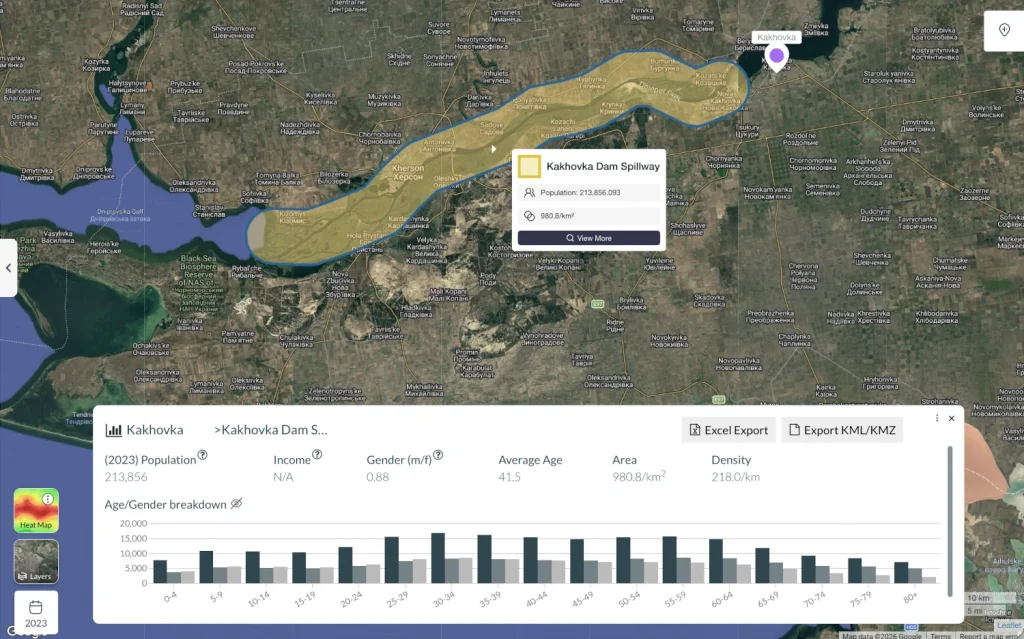
Understanding where people live is critical in high-stakes situations. In humanitarian crises, it determines where aid goes; in commercial contexts, it shapes investment decisions. The core need is the same: accurate, granular population insight that can be used quickly.
Co-founded by US-based data for development practitioner and entrepreneur, Benjamin Winters, Population Explorer addresses this need by integrating our open, high-resolution data into a practical, map-based tool. The platform supports both urgent response and longer-term planning and is offered free of charge to governments in low- and middle-income countries (LMICs), where access can be most impactful.
Humanitarian Response: Speed, Precision, and Coverage
In disaster or conflict scenarios, responders must rapidly estimate how many people are affected and where they are located. Traditional population datasets, often aggregated at administrative levels, can obscure critical detail, especially in rural or rapidly changing environments.
WorldPop improves this by modelling population distribution at a fine spatial resolution (typically ~100 metres), based on settlement patterns derived from recent satellite imagery.
Population Explorer makes this data immediately usable.
Responders can:
- Define impact zones (e.g. flood extents, conflict areas, disease outbreak regions).
- Draw buffers or travel-time catchments around key locations.
- Instantly calculate population counts within those areas.
Because the data reflects actual settlement patterns, estimates are more operationally reliable. This supports:
- Aid allocation and logistics.
- Prioritisation of response areas.
- Identification of underserved or hard-to-reach communities.
In practice, Population Explorer has been used to:
- Quantify population density across community health worker posts, to better calibrate resource allocation and service delivery in malaria control and elimination efforts,
- Establish baseline coverage targets for mass drug-administration campaigns for neglected tropical diseases (NTDs), and
- Feed zero-dose models to identify populations not reached by traditional immunisation campaigns.
For LMIC governments, free access removes most budget and technical barriers.
Beyond Crisis: Applying the Same Insight to Commercial Decisions
The same analytical capabilities also support commercial and planning use cases, such as retail site selection and franchise territory design. High-resolution WorldPop data enables decisions based on realistic population distribution rather than broad geographic averages, improving accuracy across applications.
Population Explorer provides a straightforward interface to analyse population distribution, define custom areas, and generate estimates without requiring advanced technical expertise.
Overall, a single data foundation supports multiple applications, allowing consistent population analysis across both operational and strategic contexts.
From Data to Decisions
Whether allocating emergency aid or planning a retail network, decisions depend on understanding population distribution at meaningful resolution.
By combining WorldPop data with an accessible interface, Population Explorer connects open data to real-world applications, and supports potentially faster, more accurate, and better-informed decisions wherever population insight is required.
Image: Population at risk following destruction of Kakhovka Dam, Population Explorer YouTube Channel, 2024