
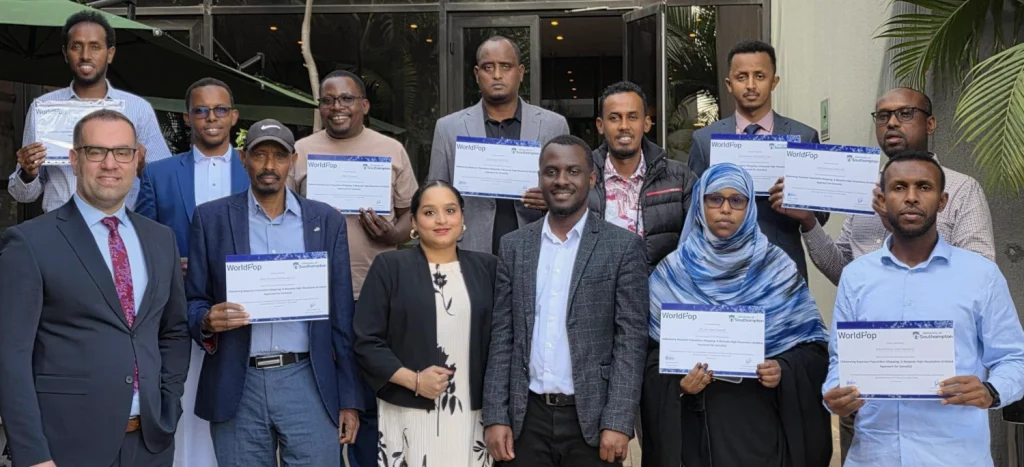
Researchers from WorldPop recently ran an intensive 10-day workshop in Nairobi, bringing together experts from the Somalia National Bureau of Statistics (SNBS) and the Somalia Country Office United Nations Population Fund. While the setting was Kenyan due to security concerns, the focus remained firmly on Somalia, where reliable, detailed population data has long been difficult to produce.
At the heart of the workshop was a powerful idea: using cutting-edge data science to map populations with remarkable precision. Participants learned how to combine satellite data, geographic information systems (GIS), and advanced statistical techniques (specifically Bayesian methods) using the R programming language. The goal was both practical and ambitious: to produce high-resolution population estimates for five districts in Somalia. Notably, this marked the first time the SNBS has conducted large-scale ground data collection using the latest technology, developed in-house following intensive training delivered through this project. It also represented a first attempt to apply cutting-edge methods to generate reliable, high-resolution population estimates disaggregated by age and sex.
This work matters because accurate population data underpins almost all major decisions governments and organisations make, from where to build schools and hospitals to how to respond to disease outbreaks. In Somalia, where a full national census has not taken place since 1975, these methods represent a significant step forward.
Led by WorldPop experts Dr Sarchil Qader, Dr Ortis Yankey, and Dr Krishnaveni KS, the sessions saw strong engagement. Participants actively applied new techniques, discussed real-world challenges, and explored how these tools could be adapted to Somalia’s context. As one participant reflected, the workshop provided hands-on experience with geospatial modelling and advanced data methods, enabled knowledge exchange with technical experts, and contributed to strengthening evidence-based planning.
The timing was critical. Outputs from the project are expected to support operational planning for health programmes, including polio vaccination efforts run in partnership with Somalia’s Ministry of Health. With more accurate data, resources can be targeted more effectively, improving outcomes for vulnerable communities.
The workshop forms part of a broader initiative funded by the Gates Foundation and delivered in collaboration with UNFPA Somalia Country Office. Beyond technical training, it also focused on building long-term capacity so that local institutions can independently generate and apply this data in the future.
Discussions during the workshop began to outline a roadmap for scaling this approach nationwide, with growing interest from Somali government leaders. The WorldPop team met with Dr Abdisalam Mahamed, SNBS Director General, and discussed project dissemination methods and ways to advocate for expansion across the entire country. While Somalis wait for the right conditions to conduct an official traditional census, the innovative methods covered in the workshop can be used to produce reliable, granular population estimates to improve current humanitarian responses and operational planning.
Image: Participants from the Somalia National Bureau of Statistics receive WorldPop workshop completion certificates