
Each year, tropical cyclones threaten more than a billion people living in low-lying coastal cities. As storms grow more intense and cities expand, the stakes are rising. But a recent study led by Dr Haiyan Liu, a visiting researcher with WorldPop, shows that multi-hazard early warnings supported by more effective use of data can dramatically reduce harm and help communities recover faster.
The research explores how countries such as China are shifting from reacting to disasters after they strike to anticipating danger before it arrives. At the heart of this shift are Multi-Hazard Early-Warning Systems (MHEWS). Unlike traditional alerts that focus on a single threat, these systems combine warnings for multiple hazards, such as strong winds and heavy rainfall, and coordinate them across national, regional, and city levels. The goal is simple: give people clear, timely information so they can take action early.
What makes this approach especially powerful is the data behind it. A key component of the study was the use of WorldPop’s open population data, which maps where people live at an incredibly fine scale – down to 100 metres. Instead of knowing that a storm is approaching a city in general, researchers could estimate exactly how many people were in its direct path, street by street.
This detailed population information was combined with anonymised, location-based data from 1.1 billion mobile devices, allowing researchers to observe how people actually responded to warnings. Did they stay home? Did they leave risky areas? For the first time, the effectiveness of early warnings could be measured not just in theory, but in real human behaviour.
The results were striking. When cities used integrated, multi-hazard warnings, human mobility dropped by more than 52% on storm days. In practical terms, this meant millions of people chose to stay indoors or move out of harm’s way. Over a single year, these decisions helped avoid 41 million person-days of direct exposure to dangerous storm conditions. Timely information, it turns out, can act like an invisible shield, protecting public health by changing behaviour before disaster hits.
The benefits didn’t stop once the storm passed. The study also found that cities using combined early warnings recovered far more quickly. Recovery times were reduced by between 55% and 76%, depending on how fully the warning system was implemented. Because people and services were better prepared in advance, cities were able to return to normal life much sooner.
Perhaps most importantly, the research highlights how data-driven warning systems can make disaster protection more equitable. Wealthy coastal cities often have better infrastructure and resources to cope with extreme weather, while less affluent or inland areas are more vulnerable. MHEWS helped narrow this resilience gap by providing a shared safety net of information. When everyone receives timely, clear warnings, a city’s ability to withstand a storm is less dependent on its budget or location.
The study also offers a note of realism. Even the best early-warning systems have limits. Extremely powerful typhoons, with wind speeds exceeding 64 knots, still cause major disruption that behavioural changes alone cannot prevent. This underscores the continued need for investment in physical infrastructure alongside data and technology.
Dr Liu, who is visiting WorldPop at the University of Southampton from the Ocean Data Center at the Southern Marine Science and Engineering Guangdong Laboratory in China, shows through this work how open data and collaboration can save lives at scale.
Behind every alert that prompts someone to stay home, move to safety, or prepare early, there is data working quietly in the background. Together, WorldPop’s population maps and multi-hazard early warnings are proving that better information doesn’t just describe risk – it reduces it.
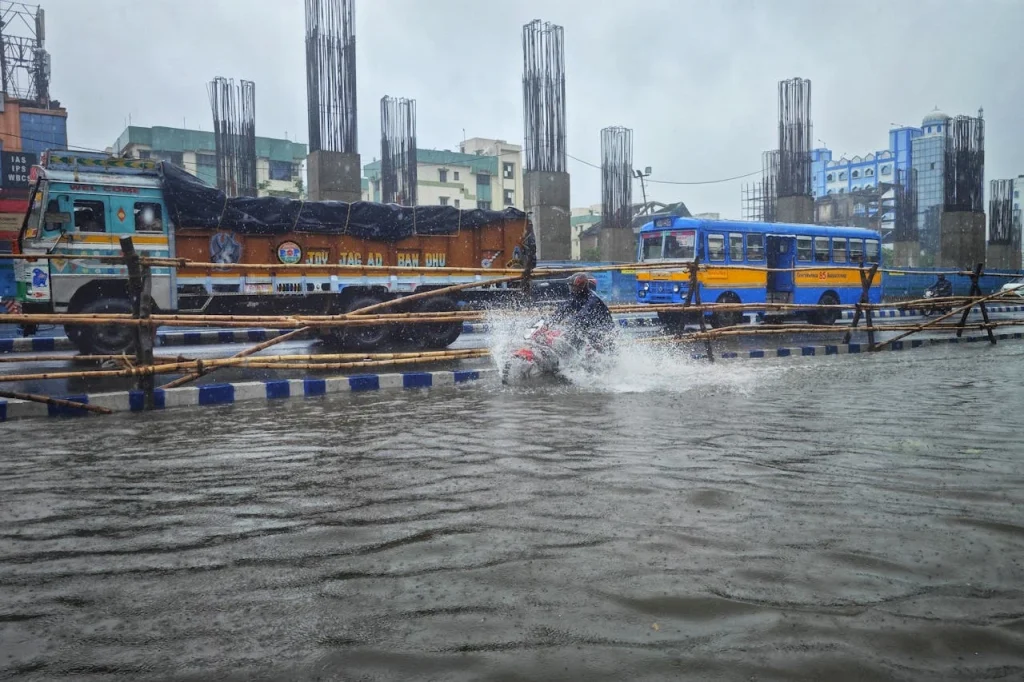
Image: Truck and Bus on Street in City during Flood, Dibakar Roy, 2024 via Pexels
We’re trialling the ‘Deep Dive’ audio summary feature of Google’s NotebookLM. This feature uses AI to create a podcast-like audio conversation between two AI-derived hosts that summarise key points of documents - in this case the “Combined benefits of multi-hazard early warnings on human mobility resilience to tropical cyclones” journal article linked below.
As Google acknowledge that NotebookLM outputs may contain errors, we have been careful to check, edit and validate this audio.
Please contact us to let us know what you think.
Music: My Guitar, Lowtone Music, Free Music Archive (CC BY-NC-ND)
Learn more
Combined benefits of multi-hazard early warnings on human mobility resilience to tropical cyclones (Global Environmental Change)
Global 2 Open Population Data (WorldPop)