
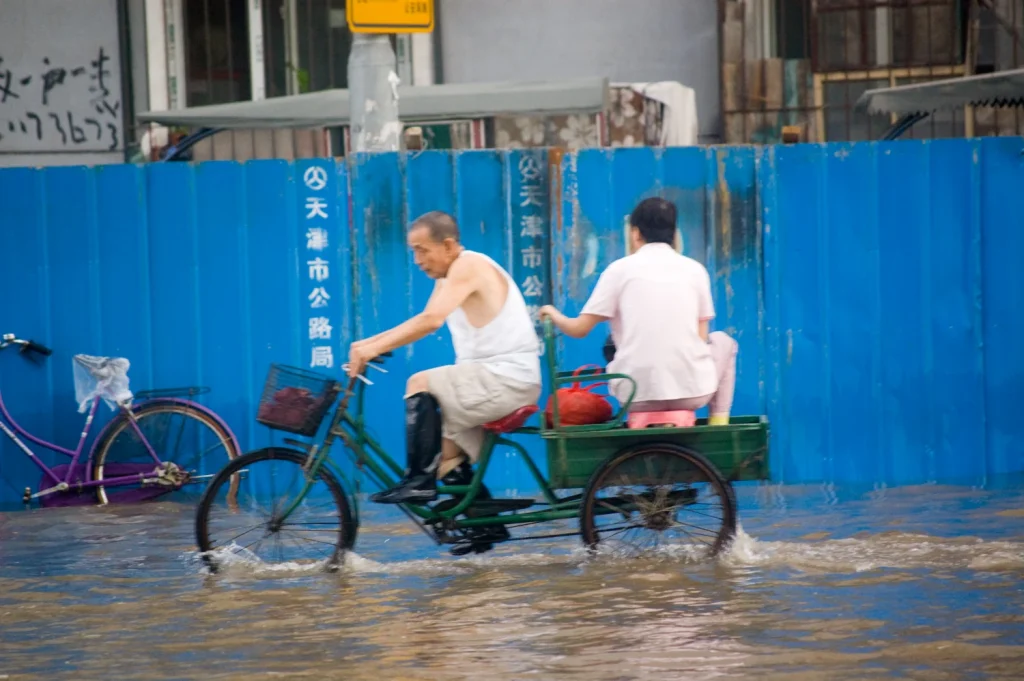
Strong intercity connections are a key factor in helping urban areas recover faster from devastating floods. A new study published in Nature Climate Change reveals that cities with robust ties to major economic hubs bounce back more quickly when extreme rainfall strikes. This research, led by WorldPop Research Fellow Dr Haiyan Liu, shows that well-connected urban networks act as a safety net during climate emergencies.
The researchers analysed anonymised and aggregated mobility data from 1.1 billion mobile devices across 366 Chinese cities. They found that conurbations with high “network centrality” experience significantly shorter recovery times following extreme storms. This term refers to cities that are well-integrated into national travel and economic systems. While rainfall causes an immediate drop in local activity, stronger links to wealthy “elite” cities help urban functionality return to normal at a much faster pace.
“Intercity connectivity constitutes a critical yet underappreciated dimension of disaster resilience,” comments Dr Liu, ” Strategic infrastructure planning can strengthen links between cities, enabling the rapid movement of resources and personnel during disasters. These connections can accelerate recovery and help avoid further economic losses. As no city can confront every extreme weather risk alone, the resilience created through intercity support must be incorporated into regional and national planning.”
The study highlights that smaller cities often see the greatest relative benefit from improved connectivity. For instance, the team’s geospatial mapping indicates that prioritising railway links in underdeveloped regions could deliver the largest gains in resilience. By 2050, strategic railway expansion could reduce economic performance losses by over 72%, potentially avoiding up to 14.2 billion Chinese Yuan in annual indirect losses.
These findings offer timely and accurate data for policymakers aiming to build climate-ready urban systems. The research emphasizes that resilience is not just a local attribute but is driven by a city’s position within a wider national network. Integrating network-oriented planning into disaster management could provide a vital lifeline as extreme weather events increase in frequency and severity globally.
This research was supported by the National Natural Science Foundation of China and the Australian Research Council.