
What could you create if you could bring WorldPop population data straight into your maps, applications and even conversations with AI?
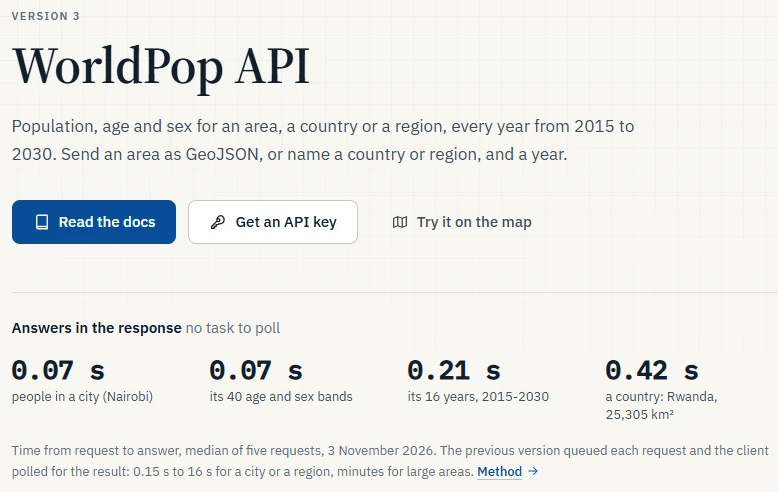
The new WorldPop API is now live, giving developers, researchers and mapmakers new ways to access our population data and build it into their own tools and workflows.
And with the 30DayMapChallenge in full swing, now is a great time to put it to the test.
From population data to your next map
Every November, the 30DayMapChallenge encourages people around the world to experiment with maps, data and new techniques, with a different creative theme every day.
There are plenty of opportunities to explore WorldPop data before this year’s challenge finishes. Interactions, Hexagons, Network and Raster all offer possibilities. But we’ve got 27 November: New tool circled in our calendar.
The challenge that day is simple: try a new tool in your mapmaking workflow.
Why not make it the WorldPop API?
Whether you’re exploring how populations are distributed, building an interactive visualisation or testing a completely new idea, take a look at the WorldPop API documentation and see where the data takes you.
And now you can ask for the data
We’re also making WorldPop data easier to explore through MCP, or Model Context Protocol.
MCP allows compatible AI assistants and agentic tools to query live data sources directly rather than relying solely on static training data. WorldPop’s MCP server can provide population figures from our models in response to natural-language questions, without the user having to write an API call.
It now provides access to the underlying 100m-resolution population grid, allowing queries below national and regional level, including individual grid cells and custom areas. It works with the same underlying 2015–2030 population, age and sex data available through WorldPop’s API v3 endpoints.
In other words: you can ask a question about population and let an MCP-compatible AI assistant talk to WorldPop’s data to help find the answer.
What will you map?
The 30 Day Map Challenge is all about experimenting, learning and sharing what you create. So whether you’re a seasoned GIS developer, an AI enthusiast or simply curious about population data, this is your invitation to try something new.