
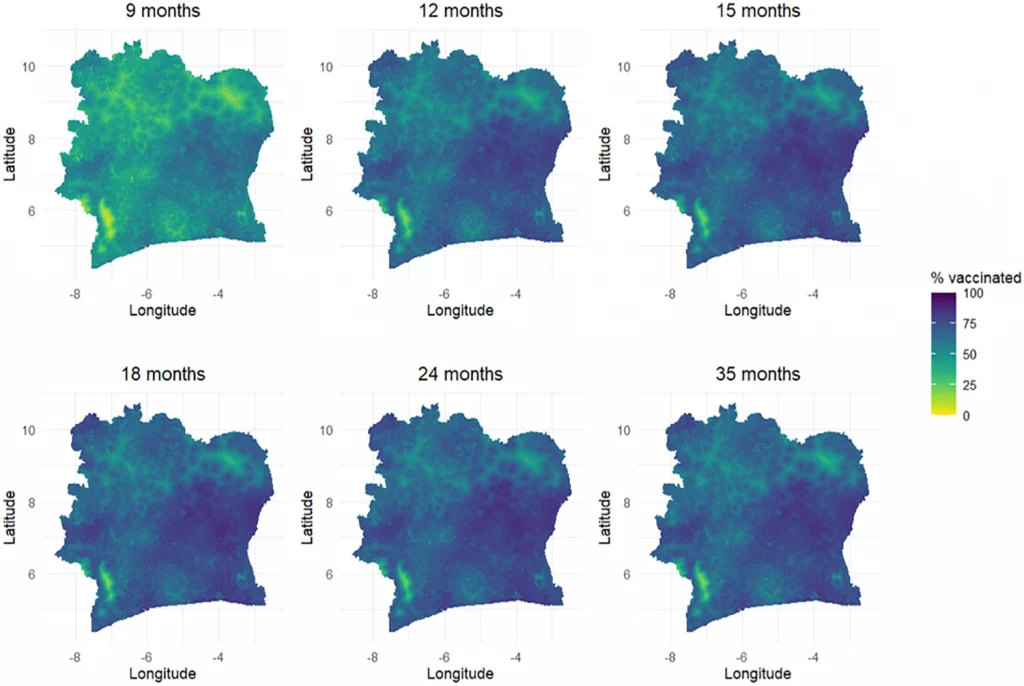
A team of international researchers led by WorldPop Associate Professor Edson Utazi, has developed a new geospatial mapping method to identify exactly where and at what age children are missing life-saving measles vaccines. Accurate and contemporary data is essential for the success of immunisation programs in low- and middle-income countries. Traditional national estimates often mask local pockets of vulnerability where disease outbreaks can ignite. This study, recently published in PLoS Computational Biology, introduces a flexible statistical model that tracks vaccination coverage at a high-resolution 1×1 km grid level while accounting for differences between specific age groups.
Measles is highly contagious, and timely vaccination in the first year of life is crucial. In many low- and middle-income countries, national statistics suggest progress, but these broad averages can hide vulnerable communities where outbreaks are more likely to occur. Without detailed data, it can be difficult for health workers to know where to focus their efforts.
The researchers used anonymised and aggregated individual-level household survey data from Côte d’Ivoire, combining it with geospatial mapping of local conditions such as walking travel time to health facilities and maternal education. Their results revealed a significant delay in the timely receipt of the measles vaccine during the first year of life. Specifically, children between 12 and 35 months of age had approximately twice the odds of being vaccinated compared to those in the 9 to 11 month age group.
Dr Utazi comments: “By showing gaps in both age and location, this approach enables health workers to target immunisation efforts more precisely, helping ensure that more children have timely protection against measles and other diseases”.
The maps identified departments in the northern and western districts of Côte d’Ivoire as having particularly low coverage among younger children. These insights help prioritise catch-up campaigns and routine immunisation strategies to close immunity gaps across different birth cohorts.
This research was supported by funding from UNICEF and Gavi, the Vaccine Alliance.
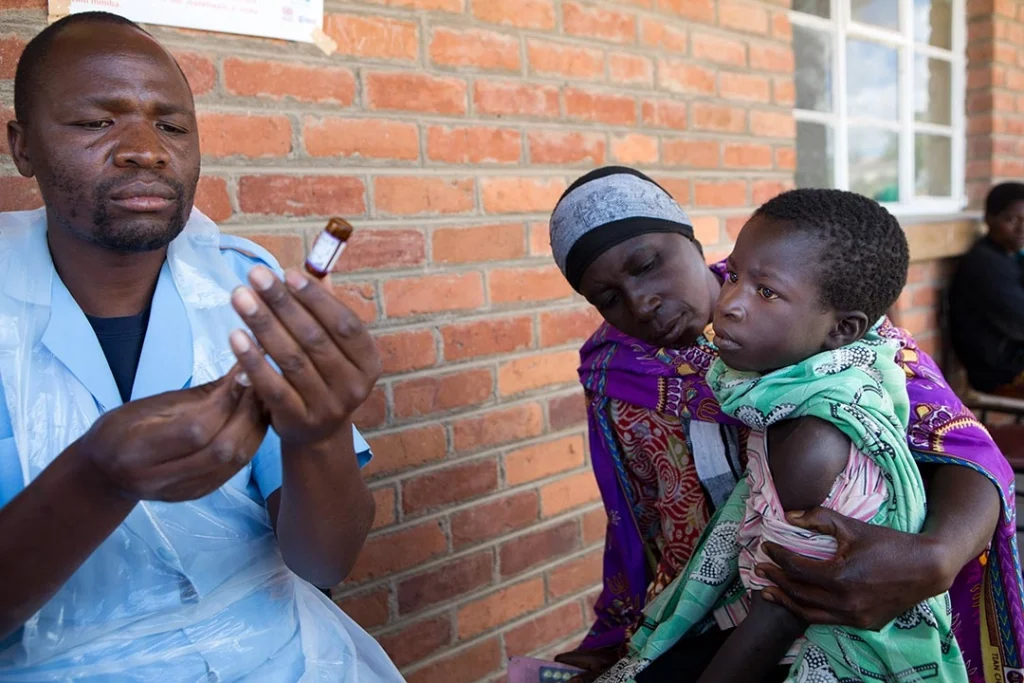
Image: Lower-income countries push to reach more than 85 million children with measles vaccine, Gavi, the Vaccine Alliance, 2022
Full journal article: An age-structured spatially varying coefficient model for high-resolution mapping of vaccination coverage (PLoS Computational Biology)