
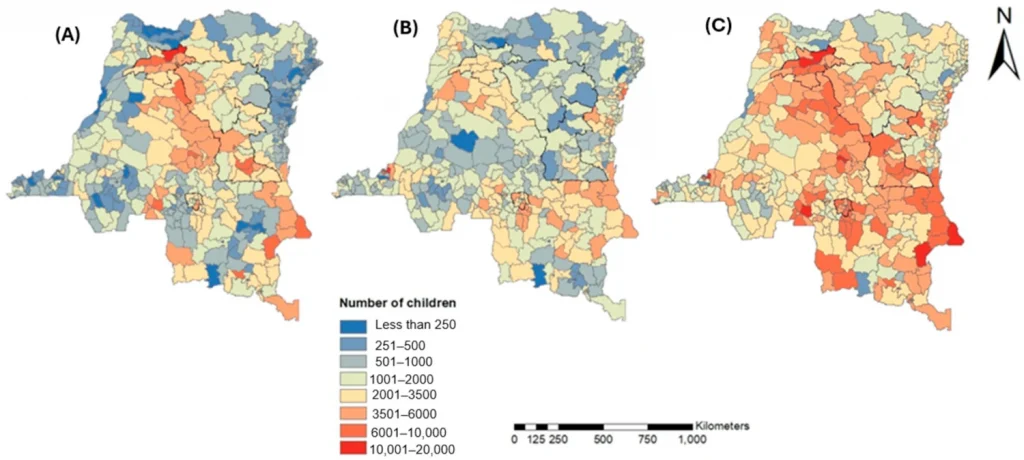
New research recently published in Vaccines maps childhood vaccination gaps across the Democratic Republic of the Congo (DRC) in far greater detail than before. Led by WorldPop researcher KS Krishnaveni, the study reveals important local variations in vaccination coverage across the DRC, providing precise, location-specific information to help immunisation programme managers and policymakers identify coverage gaps, prioritise zero-dose and under-vaccinated children, target resources effectively, and monitor progress towards national and global immunisation goals.
Researchers generated high-resolution (1 km × 1 km) estimates of DTP1–3 and MCV1 vaccination coverage across the DRC using data from the 2023 Enquête de Couverture Vaccinale (ECV) survey, conducted by the Kinshasa School of Public Health (KSPH) and covering more than 79,000 households, using a Bayesian geostatistical modelling framework. The modelling incorporated a wide range of geospatial covariates that may influence vaccination coverage, including measures of remoteness, socioeconomic conditions, population characteristics, conflict, climate and environmental factors. These data were combined with the survey information to generate vaccination coverage estimates in areas where survey data were not directly available.
Krishnaveni comments: “Our detailed maps show that significant pockets of unvaccinated children can remain hidden, even in health zones that appear to have high overall coverage. They give local teams evidence to plan outreach and use limited resources where they can make the greatest difference.”
The maps show where vaccination coverage is lower and where children are at greater risk of being unvaccinated or under-vaccinated. The researchers combined the modelled vaccination coverage estimates with high-resolution gridded population data for children under one year of age from GRID3 Inc. and WorldPop. This allowed them to estimate the number of DTP-unvaccinated, DTP-under-vaccinated and DTP3-unvaccinated children under one year of age across health zones. Nationally, an estimated 18.4 per cent (about 775,000 infants) were zero-dose children, meaning they had not received DTP1, the first dose of the diphtheria–tetanus–pertussis (DTP) vaccine. A further 20.7 per cent (around 871,000 children) were DTP under-vaccinated, having received DTP1 but not DTP3. The largest gap was for the first-dose of measles-containing vaccine (MCV1) with an estimated 46.8 per cent, or about 1.96 million children under one year of age, not having received MCV1.
The findings illustrate that although vaccination coverage appears satisfactory at higher administrative levels, significant heterogeneity and low coverage persist at the local (health area) level, underscoring the importance of conducting analyses at fine spatial scales to effectively target immunization efforts. Persistent gaps in vaccine coverage were concentrated in remote northern and eastern provinces, especially Mongala, Tshopo, Maniema and Kasaï-Oriental, emphasizing the need for targeted immunization interventions.
Yambuku health zone in Mongala faced one of the greatest challenges: an estimated 11,871 children under one year of age had not received DTP1, while 85.8 per cent of the under-one population had not received DTP3, the third and final DTP dose.
In contrast, highest coverage for all three DTP doses was found in several urbanised and well-connected areas, particularly across the central-western and southern provinces, with some grid cells showing modelled coverage of 95 per cent or higher.
The study shows that many children receive a first dose but do not return for later ones. Its detailed maps could help local teams improve follow-up, plan delivery routes and reach children who might otherwise be missed.
The research was funded by Gavi, the Vaccine Alliance, through the Zero Dose Child Vaccination Project of the Equity Acceleration Fund. Project partners included United Nations Office for Project Services (UNOPS), GRID3 Inc., the Center for Integrated Earth System Information (CIESIN) within the Columbia Climate School at Columbia University, and the Kinshasa School of Public Health.