
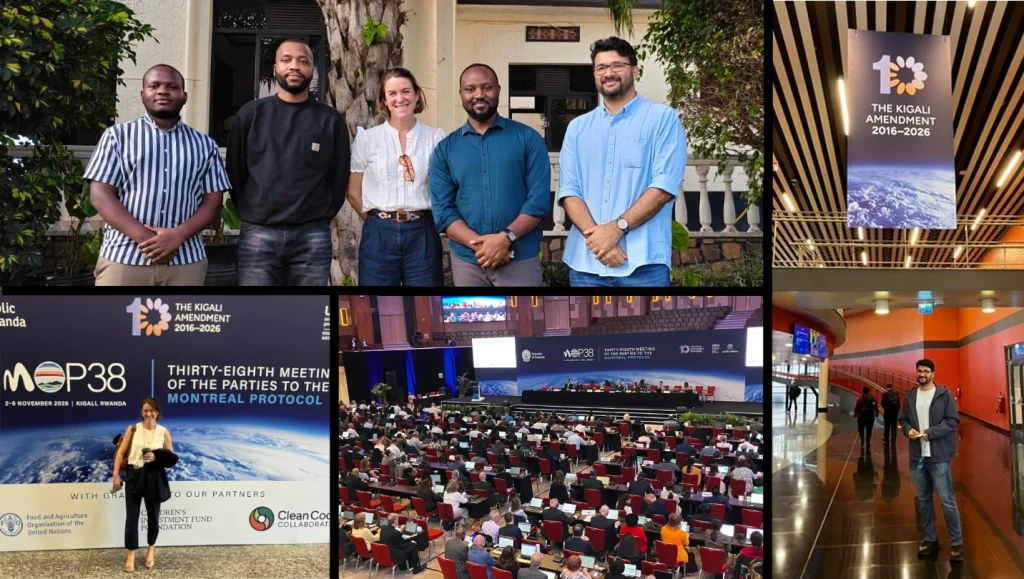
A week on from the 38th Meeting of the Parties to the Montreal Protocol (MOP38) in Kigali, I’ve been reflecting on a fascinating opportunity to see how scientific evidence informs international environmental decision-making.
MOP38 brought together governments, international organisations, industry and other partners to discuss the future of one of the world’s most successful environmental agreements. It was particularly significant because 2026 marks ten years since the Kigali Amendment was adopted, committing countries to phase down hydrofluorocarbons (HFCs), a group of greenhouse gases widely used in refrigeration and cooling.
Dr Jessica Espey and I attended MOP38 as part of our work on REIGN-MP, a four-year Horizon Europe project involving WorldPop and partners across Europe and internationally. The project aims to strengthen monitoring of ozone-depleting substances and fluorinated gases and ensure the resulting evidence better supports international policy and compliance.
Our focus in Kigali was on something that is easy to overlook: what happens to scientific evidence once it reaches the negotiating room?
Through one-to-one interviews with international civil servants and technical experts, alongside observing formal discussions, we explored how evidence is presented, interpreted and used during international negotiations. What stood out in the plenary was that scientific data is rarely treated as a static fact. Under Agenda Item 7, for instance, delegations wrestled with a 10,000-tonne discrepancy between top-down atmospheric observations of HFC-23 and bottom-up national inventory submissions. Observing the floor debates showed how quickly technical data intersects with national sovereignty and administrative capacity, particularly as countries questioned monitoring coverage and the legal reporting boundaries for non-controlled feedstocks.
Our stakeholder interviews revealed the human side of this evidence pipeline. Negotiators candidly described navigating severe information overload, noting that delegations rarely have time to digest multi-hundred-page technical reports and instead rely on concise briefs, informal bilateral calls with scientists, and accessible summaries to translate complex models into actionable policy.
REIGN-MP is ultimately about making environmental monitoring more resilient, useful and transparent. My time in Kigali reinforced that closing the gap between science and policy requires more than advanced models; it demands an understanding of the institutional pipelines and human processes that can turn that evidence into action.