
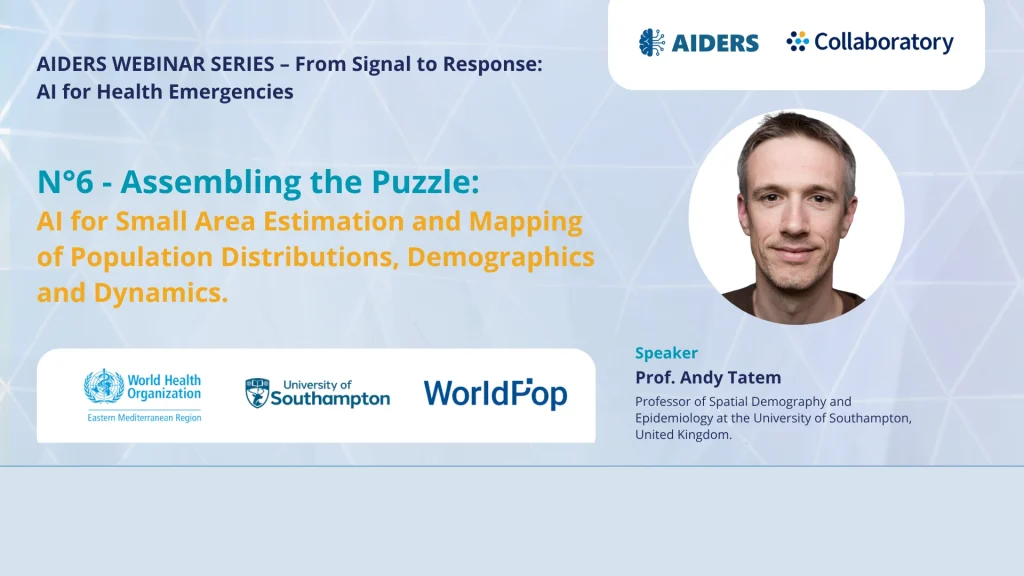
Accurate population data can make the difference between aid reaching the right communities and people being overlooked.
In a World Health Organisation Eastern Mediterranean Region AIDERS webinar earlier today, Professor Andy Tatem explored how geospatial data and artificial intelligence can help fill crucial information gaps, particularly where censuses are outdated, incomplete or impossible to conduct.
WorldPop researchers combine population data with sources including satellite imagery, building footprints, land cover and mobility data. These can be used to produce detailed population estimates that help organisations understand where people live, how populations are changing and who may struggle to access essential services.
The approach has practical applications ranging from vaccination planning and locating health facilities to disaster response and census preparation. But Prof Tatem stressed that AI and modelling should complement, not replace, traditional demographic data. Reliable local data remains essential for training and validating models, while uncertainty needs to be understood and communicated.
The webinar also offered a glimpse of where the WorldPop team are taking population data next.
During a live demonstration, Prof Tatem previewed new functionality being developed for the WorldPop AI-powered portal. Rather than simply viewing a population map, users will be able to draw their own area of interest and quickly explore its estimated population, age structure and how it has changed over time. They will also be able to compare the population profiles of different places.
Prof Tatem demonstrated the tools using locations including Syria, Kabul and Muscat, moving from global population datasets to information tailored to a particular place. Combined with WorldPop’s AI assistant, which allows people without specialist GIS skills to query population data using everyday language, the direction is towards making complex demographic evidence much easier to explore and use.
For disaster and emergency response, that accessibility could be particularly important. The question is no longer simply whether detailed population estimates can be produced, but how quickly people making decisions can turn them into useful local information.
Key questions from participants
Potentially. Prof Tatem explained that where suitable geolocated survey data exists, modelling can sometimes estimate characteristics such as poverty, literacy or sanitation at smaller scales. However, the results depend on the strength and quality of the available data.
WorldPop’s work is generally designed around open-source approaches, with APIs available to help users query data and develop their own applications.
Gridded population estimates offer flexibility because populations can be estimated independently of administrative boundaries and then aggregated according to the boundaries required by different users.
Yes. Spatial data can be accessed through an API. Prof Tatem also stressed the importance of checking global building datasets against local knowledge, particularly for nomadic, temporary or otherwise easily missed settlements.
Yes, but there is no single tool for every problem. The most useful applications are designed around a clearly defined need, such as disease surveillance, healthcare preparedness or responding to climate-related disasters.
Yes. In Burkina Faso, for example, WorldPop used bottom-up modelling to estimate populations in areas inaccessible because of insecurity, before using census data in a top-down approach to create gridded estimates. Hybrid approaches remain an active area of research.