
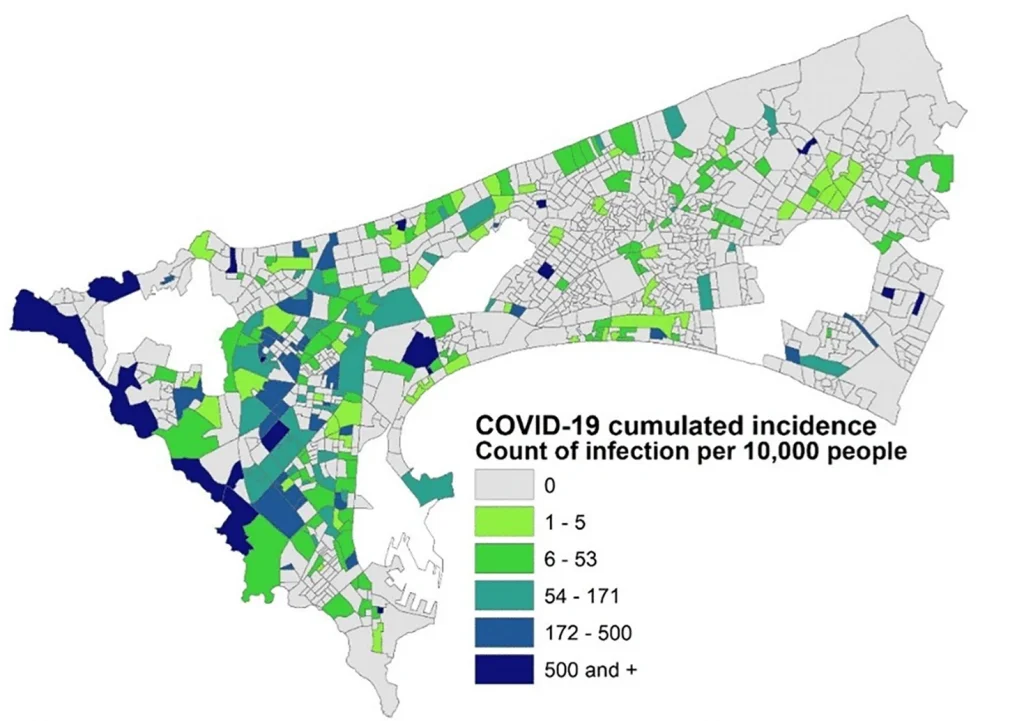
A new study by an international team of researchers has successfully mapped the neighbourhood-level spread of COVID-19 in Dakar, Senegal, revealing that high-density residential areas in the city’s west face the greatest risk of infection. The research, led by WorldPop Research Fellow, Dr Assane Gadiaga at the University of Southampton in collaboration with the Université Cheikh Anta Diop, provides a useful blueprint for low- and middle-income countries to target life-saving health interventions where they are needed most.
By integrating anonymised epidemiological records with high-resolution satellite imagery, the team developed advanced geospatial mapping to track how the virus moved across the city between June 2020 and June 2021. The study highlights a critical “hidden” risk: while general population density is often blamed for disease spread, the researchers found that “adjusted population density” – the number of people specifically within built-up living spaces – is the true driver of infection.
“Accurate, contemporary data is the cornerstone of effective pandemic preparedness,” says Dr Gadiaga. “Our models show that by identifying localized transmission patterns, health authorities can optimize resource allocation and mitigate the impact of future outbreaks in fragile health systems”.
The findings show that western neighbourhoods, including Fann-Point-E and Plateau, are at significantly higher risk compared to the less densely populated eastern periphery. These results were achieved using the WorldPop database and complex Bayesian spatio-temporal modelling, which allowed the team to account for both geographical clustering and changes over time.
This research is particularly urgent as new virus variants continue to emerge. The study’s methodology offers a flexible tool that can be adapted to combat other endemic diseases, such as malaria and tuberculosis, across the African continent.
The study, Spatio-temporal modelling of COVID-19 infection and associated risk factors in Dakar, Senegal, is published in the journal PLOS Global Public Health. This work was supported by the Gates Foundation and the National Institutes of Health.