
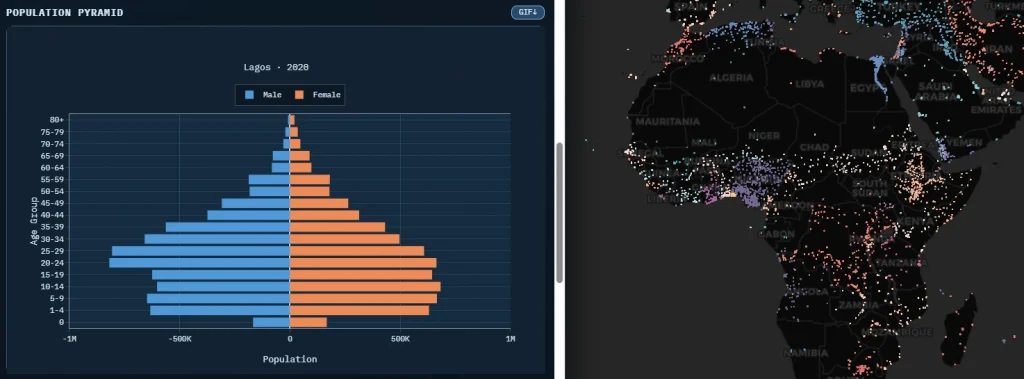
High-resolution data from WorldPop is uncovering critical demographic shifts in over 10,000 cities that national averages often hide. The study, led by Dr Andrew Zimmer and published in Nature Cities, provides a globally consistent view of urban change between 2000 and 2020.
Researchers used WorldPop’s anonymised and aggregated gridded population distributions to track age and sex structures at 1km spatial resolution. This open-access resource is valuable for decision-making in low- and middle-income countries, where census data can be outdated or limited. By mapping these “pixels” of human activity, the team identified how migration and natural growth uniquely shape different urban centres.
Dr Zimmer comments: “This is one of the first efforts to map demographic details to learn more information about who lives in these cities and how that’s changed over time.”
The findings highlight that smaller cities, particularly in Africa, remain significantly younger than larger hubs and require targeted infrastructure investment. Access to this contemporary data ensures that resources can be allocated to support the most vulnerable populations during environmental hazards like heatwaves.
This research was supported by NASA’s Land-Cover and Land-Use Change program, and technical support was provided by the University Information Technology Research Cyberinfrastructure at Montana State University.