
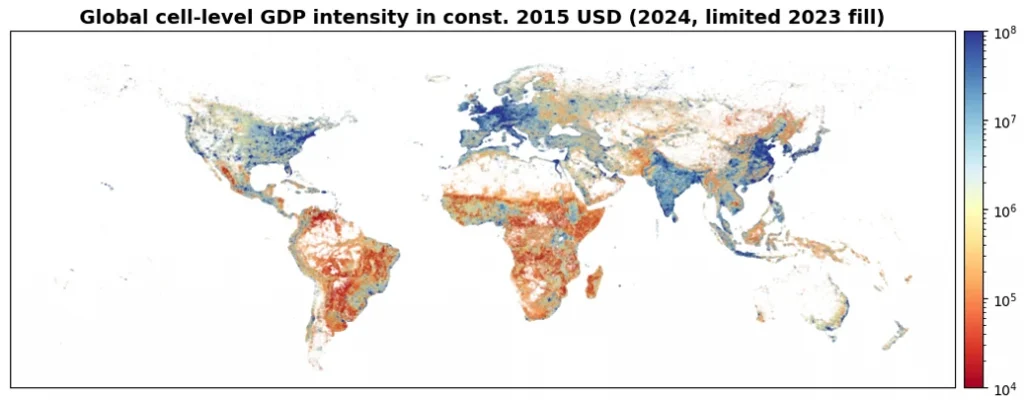
A new World Bank policy research working paper demonstrates how artificial intelligence and open geospatial data can help governments understand economies at a far more detailed local level.
Many important statistics, such as GDP, poverty, infrastructure access, or disaster risk, are usually reported only at national or regional levels. That makes it difficult to see what is happening within cities, rural communities, or local economies. The World Bank’s research team, Dr Kamwoo Lee, Brian Blankespoor, and Dr David Newhouse, have addressed this problem by using graph neural networks (GNNs), a form of AI designed to analyse relationships across connected locations.
One of the most significant aspects of the paper is its use of openly available geospatial datasets, especially population estimates from WorldPop. The researchers combine WorldPop population data with satellite night-light imagery, OpenStreetMap infrastructure data, and land-cover information to create fine-scale economic maps at global scale.
WorldPop’s contribution is particularly important because it provides high-resolution population estimates for places where census data may be outdated, incomplete, or unavailable. The paper notes that WorldPop recently released global population estimates at 100×100 meter resolution through to 2030, creating new opportunities for development analysis and policy planning.
The result is a system capable of estimating economic activity for small geographic cells across the world while remaining consistent with official national statistics. This kind of fine-scale mapping could support disaster response, infrastructure investment, poverty targeting, climate adaptation, and public service delivery in regions where traditional statistical systems are limited.
More broadly, the paper demonstrates how open data ecosystems like WorldPop are foundational infrastructure for AI-driven development research. By combining openly accessible datasets with modern machine learning, researchers can generate insights that were previously impossible.
Image: Global map of estimated fine-scale economic activity for 2024, using 2023 where unavailable. World Bank, 2026.