
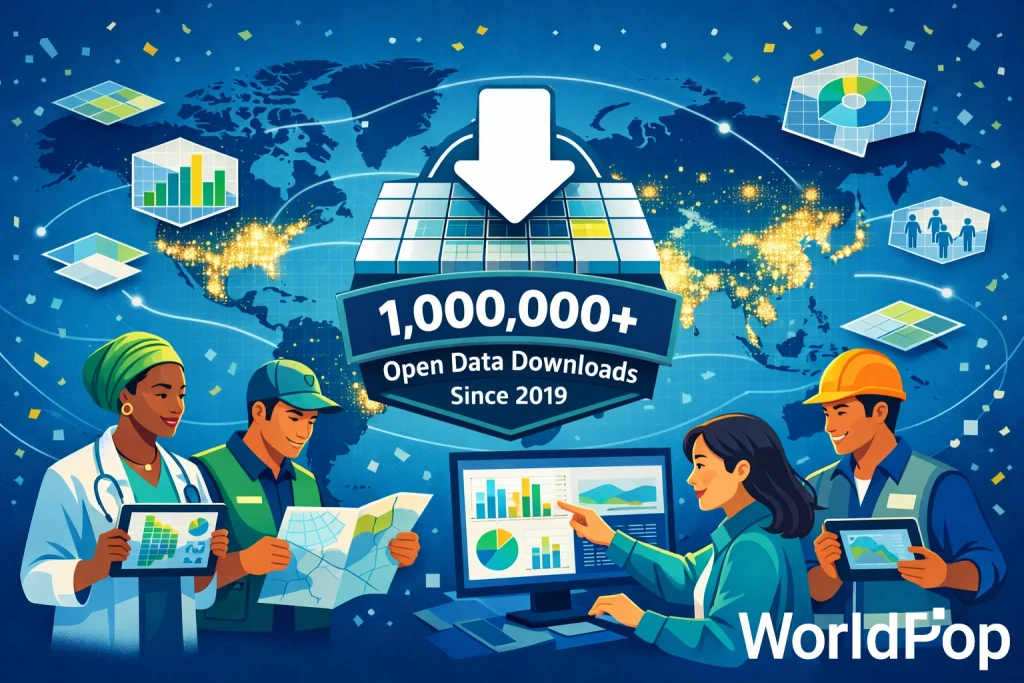
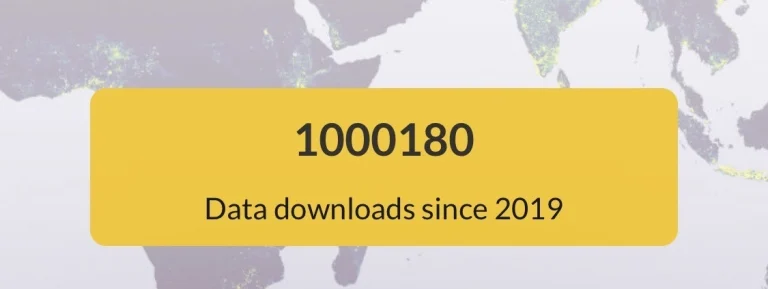
We’re thrilled to celebrate a major milestone in our mission to ensure that everyone, everywhere is counted in decision-making. Since 2019, our open spatial demographic datasets have reached over 1 million downloads from our own site – adding to the hundreds of thousands more from our data hosting partners including HDX, ESRI’s Living Atlas, and Google Earth Engine. This achievement reflects the strong global demand for high-resolution, contemporary population data to support health and development applications.
WorldPop is an interdisciplinary applied research programme at the University of Southampton, bringing together geographers, data scientists, and technical experts. Since our founding in 2013, we’ve grown into a global, multi-sector team with a clear purpose: to provide open, accessible, demographic data that supports progress toward the Sustainable Development Goals. Governments, UN agencies, researchers, and NGOs around the world use our data to plan services, respond to crises, and measure development.
Our work involves integrating diverse data sources, including those from satellites, surveys, and mobile networks to create high-resolution population estimates. We provide a wide range of peer-reviewed datasets through our Spatial Data Infrastructure (SDI), including:
- Population Distributions: High spatial resolution estimates of where populations live.
- Demographics: Detailed datasets on subnational age and sex structures, births, and pregnancies.
- Development Indicators: Mapping of critical factors like literacy, poverty, and malnutrition.
- Population Dynamics: Tracking migration flows and global settlement growth.
A recent advance in our data offering is the Global 2 annual population data covering 2015–2030, launched in September 2025. These future-looking datasets help decision-makers analyse trends and plan ahead in a rapidly changing world. 30,000 downloads so far from the WorldPop site alone, shows how vital these estimates are – especially for governments and international agencies responding to challenges like rapid urbanisation, climate change, and public health emergencies.
We believe in transparency and accessibility. Whether you are a researcher using our REST API, a developer utilizing the WOPR API, or a GIS specialist using our QGIS and ArcGIS plugins, we provide the tools you need to harness spatial demographic data. By partnering with organizations like UNFPA, GRID3 and the Countdown to 2030 initiative, we continue to co-develop solutions that empower communities worldwide.
Help shape the future of WorldPop open data
As we celebrate one million downloads, we’d love to hear from you.
Please take a few minutes to complete our anonymous survey and tell us how you use population data, what works well, and what could be better. Your responses will contribute to the next generation of WorldPop’s open population data helping us shape datasets, tools, and features that better support your work.
Thank you for being part of our journey. We remain committed to providing the open data needed to understand change, plan effective action, and build a more inclusive future.
Learn more
- WorldPop Case Studies
Our latest collection of case studies highlights the diverse global impact of our work. - WorldPop Data Portal
Access high-resolution population data used for survey design, planning and SDG monitoring. - WorldPop Data Hub
Explore and download open demographic and geospatial datasets from around the world. - Geospatial Tools & Services
GIS services, APIs and plugins supporting national statistical offices and partners. - WorldPop data on HDX, Living Atlas, and Google Earth Engine.
- WorldPop Learning Resources
Build your geospatial skills with free, expert-led, self-paced materials.
How to cite WorldPop Open Data
Suggested Citation for Global 2 Population Counts 2015-2030
Bondarenko M., Priyatikanto R., Tejedor-Garavito N., Zhang W., McKeen T., Cunningham A., Woods T., Hilton J., Cihan D., Nosatiuk B., Brinkhoff T., Tatem A., Sorichetta A. (2025). Constrained estimates of 2015-2030 total number of people per grid square at a resolution of 3 arc (approximately 100m at the equator) R2025A version v1. Global Demographic Data Project – Funded by The Bill and Melinda Gates Foundation (INV-045237). WorldPop – School of Geography and Environmental Science, University of Southampton. DOI:10.5258/SOTON/WP00839